
Tested: Honda Prelude’s Summer Tires Help It Corner Harder and Stop Shorter
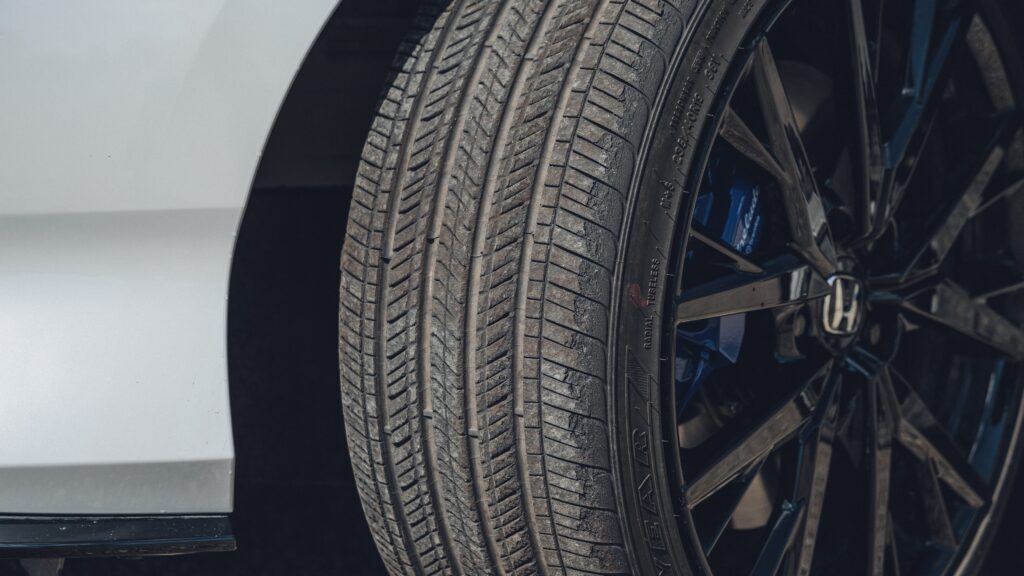
- Despite a humdrum hybrid powertrain, the 2026 Honda Prelude handles like a dream, and it offers two types of tires.
- A set of Goodyear Eagle Touring all-season tires is standard, but Continental ExtremeContact Sport 02 summer tires are a $1200 dealer-installed option.
- We’ve now tested one Prelude on all-season tires and another with summer rubber, and the results show the latter set helped it corner harder and stop shorter.
Welcome to Car and Driver’s Testing Hub, where we zoom in on the test numbers. We’ve been pushing vehicles to their limits since 1956 to provide objective data to bolster our subjective impressions (you can see how we test here).
Like most enthusiasts, we were a bit disappointed by the 2026 Honda Prelude’s firepower—or lack thereof. Now that we’ve tested a Prelude on its standard all-season tires, rather than just the set of sticky summer rubber on the first car we tested, we have the full picture of the little coupe’s performance. Unfortunately, switching from the all-season tires to dedicated summer performance tires doesn’t do as much as we initially hoped—but, fortunately, the grippier rubber does improve the sporty coupe where it counts.
Michael Simari|Car and Driver
We should start by saying that the Prelude’s optional stickier tires didn’t do squat for acceleration. Reaching 60 mph took an identical 6.5 seconds in both cars. With the Atkinson-cycle 2.0-liter four-cylinder engine and hybrid components working together to supply just 200 horsepower, the Prelude is never wanting for straight-line traction. Still, we wanted to see what differences appeared with a set of Goodyear Eagle Touring all-season tires in place of our initial test car’s Continental ExtremeContact Sport 02 tires (available as a $1200 dealer-installed option). Here’s how the test figures stack up.
As expected, grip levels improved by a considerable margin. The 19-inch Goodyear all-seasons and Continental ExtremeContact summer tires are identically sized at 235/40R-19 (ZR-19 for the higher-speed-rated Contis). The all-seasons gave in to lateral g-forces around the skidpad at 0.90 g, serving up moderate understeer in the process. The Continentals held on until 0.97 g, and kept understeer much more in check.
Marc Urbano|Car and Driver
The higher-performance tires held their own during our braking tests as well. We brought the summer tire-equipped Prelude to a stop from 70 mph in 152 feet, while the all-season Prelude needed 169 feet, a sizable 17-foot difference.
For a car posited as something of a touring car, tire noise is an important metric. It’s also another area where the summer tires win out over their all-season counterparts. At 70 mph, the Continentals contributed 71 decibels and 27 sones of noise inside the Honda’s cabin compared with the Goodyears’ 74 decibels and 34 sones at the same speed.
How much the Prelude’s test results truly move the needle is up to each buyer, but if you’re looking to eke out some extra performance from Honda’s little coupe, a set of sticky tires does the trick.
More on the Honda Prelude
➡️ Skip the lot. Let Car and Driver help you find your next car.
Jack Fitzgerald’s love for cars stems from his as yet unshakable addiction to Formula 1.
After a brief stint as a detailer for a local dealership group in college, he knew he needed a more permanent way to drive all the new cars he couldn’t afford and decided to pursue a career in auto writing. By hounding his college professors at the University of Wisconsin-Milwaukee, he was able to travel Wisconsin seeking out stories in the auto world before landing his dream job at Car and Driver. His new goal is to delay the inevitable demise of his 2010 Volkswagen Golf.
Source: www.caranddriver.com — article syndicated from the publisher’s feed; all rights remain with the original publisher.