
Are Tesla’s claims for its new ‘flying’ Roadster real, or is it just full of cold gas?
Tesla has finally re-unveiled its next-generation Roadster, originally unveiled in quite different form back in 2017. So since I did a technical breakdown of how it would work last time, I thought I’d give a quick update with what we know about the new version.
Back in 2017, the Roadster was unveiled as the car that would “give a hard-core smack down to gasoline powered cars.”
At the time, electric cars had already proven themselves with extremely quick acceleration numbers. But there weren’t many true electric sportscars (except, of course, the original Tesla Roadster from 2008, the car that started it all).
The next-gen Roadster was intended to change that, with a smaller, low-to-the-ground car built for speed, rather than comfort or efficiency. Of course, you’d still get some of those other goals as with any EV, but the idea was to win races, to beat gas cars around a track.
Advertisement – scroll for more content
And then…. a decade happened. It’s been almost 9 years since that car was first shown off, and Tesla has not released it. Meanwhile, plenty of other companies have released their own electric sportscars, and set records in doing so.
The Rimac Nevera R hit 300km/h (186mph) a full 3.5 seconds faster than a Bugatti Chiron Super Sport, the Xiaomi SU7 Ultra – made by a smartphone company – set a Nürburgring record, and Porsche went even faster, electrically. And another Chinese company, BYD, showed off that its car can jump, an artifact of its active suspension system.
There are even some tricky, fully track-focused EVs that have beaten every car ever with truly videogame-like performance, and the ability to drive upside down – you can even buy it.
So the path Tesla intended to forge is looking less like an untamed wild, and more like a well-tread trail at this point. Maybe everyone hasn’t marched on it, but Tesla is no longer the first.
But Tesla has had the most impressive demo, you have to give it that.
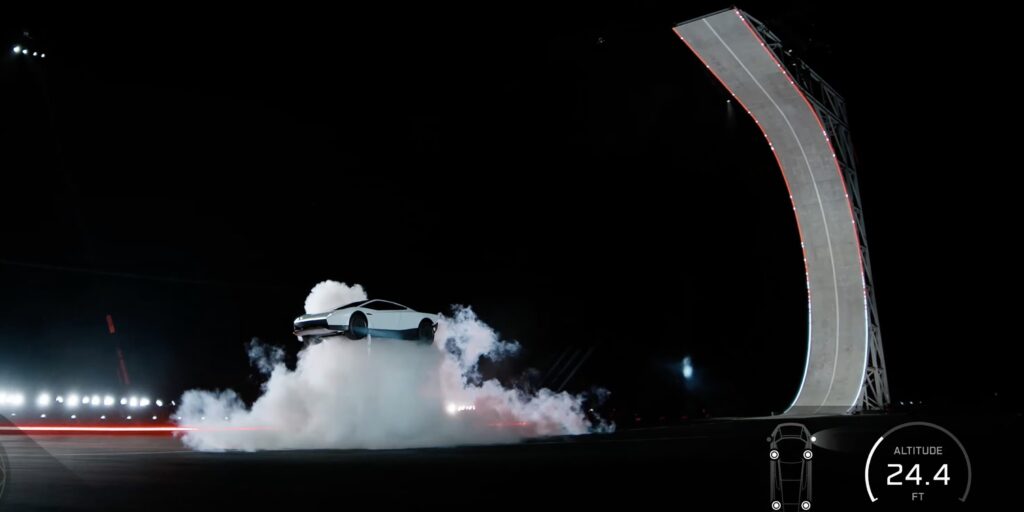
In its demo, it made some wild claims about the car – and then backed them up. Musk said the car would be able to fly, and it did. It did a flip in the air as well. It accelerated from 0-60 in under 1 second, a number that no other car has gotten even close to. It drove upside down.
How did it do all these things, and what do they mean? Will they help the car beat every track record around the world, as Musk promised tonight? Well, it’s time for a quick primer on vehicle dynamics.
Driving upside-down
The first demo showed the Roadster driving up a hot wheels-like track, going fully vertical, and then upside down.
This was accomplished through a “fan car” system, like the McMurtry Spierling, the other car which drove upside down and was mentioned above. Tesla calls it a “multi-mode suction system”
Fans on the vehicle are used to create a low pressure zone underneath the car, causing ambient air pressure to push the car against the surface it’s stuck to. This is enabled by skirts underneath the vehicle which seal off the vehicle underside so air can’t ingress into the low pressure zone.
This was described in a patent, and is a clever improvement on McMurtry’s system and previous fan car systems, as it allows the skirts to be adjusted so the car can be used in a wider array of circumstances other than smooth track surfaces.
The downforce numbers on Tesla’s display are incredibly high, and seem potentially unreal to me. There’s no need for 4,700kg of downforce on what is presumably a sub-2,000kg car. Musk did mention that Tesla wanted to keep the car “light”, and while many supercars these days push 2,000kg and more, there’s no way a 2 seater is that much heavier than that benchmark.
In comparison to the McMurtry Spierling, that car is around 1,000kg and pulls around 2,000kg of downforce to do the things it does. So Tesla is not just running more ridiculous downforce numbers, but also running a larger ratio of weight to downforce than McMurtry’s car. It’s not completely out of the question that it’s running 4,700kg, but that number is still surprisingly large to me and I wouldn’t be surprised if some liberties were taken.
Jumping off the ramp, then landing. Also, a kickflip
The next trick involved driving up the ramp, jumping off the end and then landing.
This uses the vehicle’s “cold gas thrusters” that have been placed around the car.
Tesla announced separately that the car would come with three trim levels: Performance, Thrust, and Rocket. Rocket is the only one that is “air ready,” and has cold gas thrusters mounted around the vehicle, including underneath, which allow it to fly for short distances.
This is done by compressing air and holding it in tanks onboard the vehicle. While other trim levels are 2-seaters, the “Rocket” trim only has one seat – with the space for the other seat presumably taken up by larger gas tanks so the car has enough juice to fly for short distances.
Tesla also showed off the car doing a “kickflip” over the rest of its vehicles, which uses the same technology as the jump did.
This made for an impressive demo, but offers no real performance benefit in terms of driving.
The fan car system provides additional downforce – this is because tires can only work so hard, and adding apparent weight to a car while maintaining its mass (yes, these are two different things!) can make those tires work harder. This helps in basically anything you would want to use tires for – so, y’know, every aspect of vehicle performance.
But rockets that push the car upwards do not do any such thing. Those provide “upforce,” which is a word that nobody has uttered because it’s not something you want – unless you’re trying to play a
Source: electrek.co — article syndicated from the publisher’s feed; all rights remain with the original publisher.