
Porsche’s Driving School Won’t Just Teach You How to Be a Better Driver. It’ll Teach You About Yourself
Like most things in life, there’s no cheat code to become a faster driver. It takes instruction from someone who knows what they’re doing, but beyond that, it takes repetition. Enough repetition, ideally, that you stop actively thinking about what to do in a specific situation, and the right behavior becomes your natural, automatic response.
The road to get quicker is a long one and truly never-ending if you’re committed enough. I appreciated just a piece of that journey out in Birmingham, Alabama, at Barber Motorsports Park, courtesy of the Porsche Track Experience (PTX) program.
I’ve been fortunate enough in this line of work to attend a few performance driving schools. I drove an S197 Ford Mustang at Virginia International Raceway through Skip Barber. I also attended Bridgestone’s Winter Driving School in Colorado, where I whipped (to the best of my ability) a GR Corolla around a frozen circuit built on piled hay. Both of these experiences were illuminating, but neither was as strenuous as Porsche’s two-day Performance class at Barber.
This is Porsche’s introductory program. It’s the first course on a menu that extends to the Masters and Masters RS classes, where participants can apply for an SCCA Full Competition license, as well as invitation-only, off-site events. There’s also an abbreviated, single-day option, called Precision. To be brutally honest, though, one day just isn’t enough to begin unlearning old habits and pushing yourself.
Also, to get the bill out of the way, two days of training at Barber costs $5,000. Breakfast, lunch, and the first night’s dinner are all included, and accommodation is up to you, though discounted room rates are offered at a specific hotel. For those of you situated on the West Coast, Porsche runs a similar program at Laguna Seca that goes for $6,700. That’s the price of being in Northern California, I suppose.
The Class
These are full days of work, more or less starting with breakfast and a classroom session at 7:30 a.m. If you’re familiar with the eternal performance driving precept of “string theory”—which essentially boils down to, you can’t ask the car for maximum steering and maximum acceleration or braking at the same time—you’ll cover it and other ideas there.
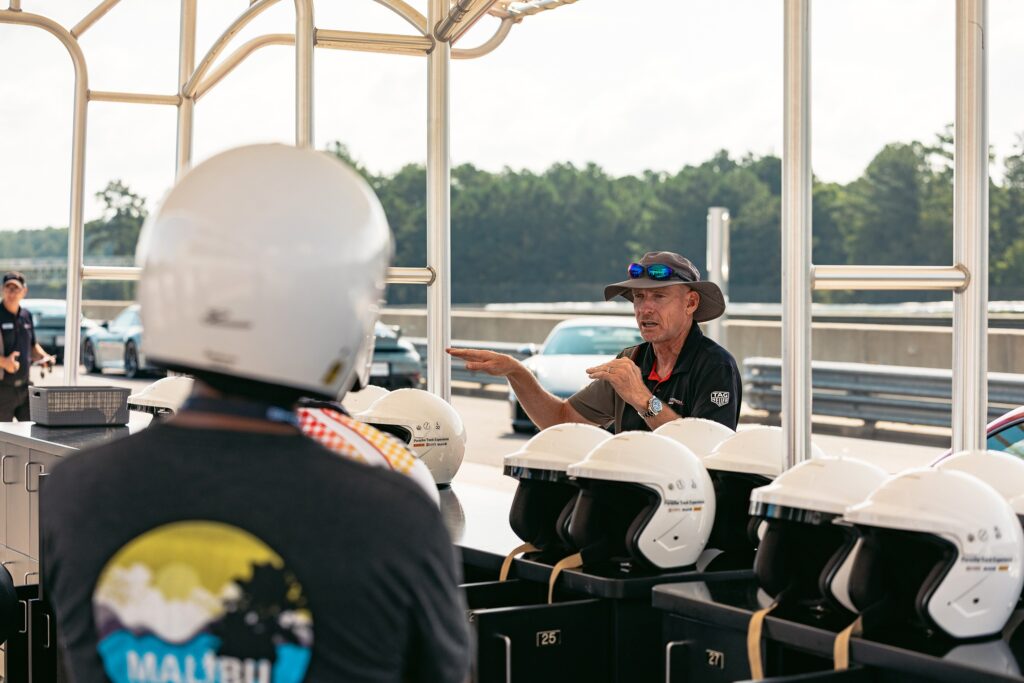
Next you’re placed in groups, where some of you head to the track to turn laps in individual vehicles behind an instructor, while others take on exercises in car control on the skidpad, practicing braking, and doing a little autocross. Then you switch. After lunch, you repeat the morning’s schedule, but the off-track activities are tweaked or stepped up, in one way or another. Do that all twice, pick up that diploma, and then you go home.
Porsche
Sounds simple, right? Rough math suggests that between both days, my peers and I each turned between 60 and 70 laps around Barber, which, as I’ll get into later, happens to be a phenomenal racetrack. Again, that’s not counting the exercises, which are laser-focused on particular aspects of fast driving that, if all goes according to plan, you’re applying the very next time you’re out there on the real stage. It’s repetitive, but seat time is the only way you learn in this business.
I’m extremely lucky to get to drive so many amazing cars as part of my job, but I’ve never quite felt as comfortable as I did midway through my stints at PTX Birmingham. When I track a car for the first time, I’m pretty sheepish. I wonder when I’ll approach a limit—mine, if not necessarily the car’s. I can get anxious about that process and what that’ll feel or look like. But you build speed in this program so methodically and progressively that eventually, you look back and realize the pace has seriously picked up since yesterday morning. And that’s a fantastic feeling.
All the while, you’ve got a radio in your car with an instructor on the other end, peppering you with feedback and advice—get over to that apex, hit the gas, turn the wheel more, loosen up those fingers. They don’t sugarcoat anything, and they don’t miss much. They’re the true strength of this program. The attention to detail and professionalism of the team at PTX Birmingham is simply next-level. They’re all racers, of all ages and all walks of life, and they all want to see you improve and safely enjoy yourself, no matter where you’re at in your journey as a driver.
The autocross course was set up within one of Barber’s parking lots. It reminded me that autocross is pretty much the safest and most accessible way to get faster and have a blast in the process. Porsche
It’s a supportive atmosphere but also a draining one. It kind of has to be. Reflecting on all of this days later, I tried to pinpoint the moment I felt like I grew as a driver. Honestly, it happened overnight—and I don’t mean that figuratively. By 4 p.m. or maybe earlier on my first day of instruction, I was spent. I found myself pushing too hard and making mistakes—not seriously costly ones, mind you, but barely missing braking points, choosing weird lines, and going on power at inopportune times. They’re little things in the grand scheme, but of course, they’re the things that separate us from those that get paid to do this.
I had to hit that mental and physical wall, get out of the car and say, “that’s it,” so I could get back in tomorrow, refreshed and ready to drive again, consciously and, to some degree, subconsciously embodying the lessons I was taught. That’s when I reckon real progress was made. For someone who’s never known how to take a breather and walk away when things aren’t clicking, this was a revelation.
The skidpad exercises were, unsurprisingly, a lot of fun. You’re asked to create an understeer situation, followed by an oversteer situation, and react accordingly. It’s the only time when traction control is switched off during your activities. Drifting is not the objective, of course, but human nature is what it is. Adam Ismail
It’s a matter of pacing yourself and, well, the obvious things. There’s a reason that one of the core things they teach you in driver’s ed—looking where you want to go, for starters—applies to the track, too. There are, of course, cones and posts on the track to denote braking points, shimmy you toward the optimal line, and focus your eyes on the apex. The job at hand is obviously more open-ended when you lack those guides. But, for our purposes, the combination of Barber and the 911 Carrera GTSes we spent most of the two days driving was a match made in heaven.
Car and Track
It’s funny to me that the “midrange” 911 today is capable of a nearly 200-mph top speed, and zero to 60 mph in under three seconds. That was exclusively the domain of supercars in my youth; today, it’s something that anyone could steer around a track and, so long as they’re actually listening to the instructors, do so with total confidence and relative comfort. The advent of systems
Source: www.thedrive.com — article syndicated from the publisher’s feed; all rights remain with the original publisher.