
Subaru Reveals First Details of New EV Platform Coming in 2029
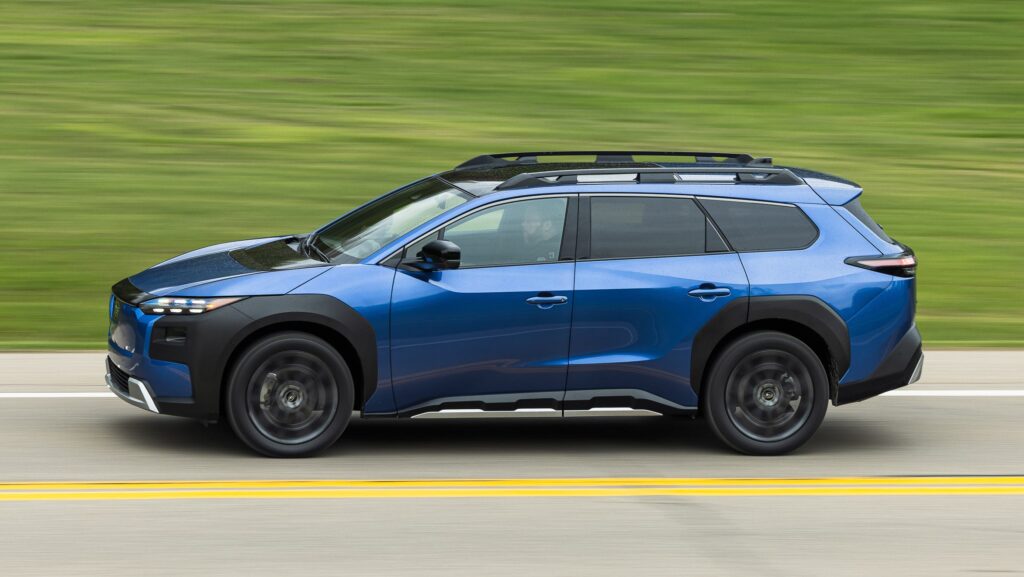
- Subaru revealed the first details of a dedicated EV platform that it developed in-house, as reported by Automotive News.
- The company showed a test mule based on an Outback but with two electric motors providing all-wheel drive and around 510 horsepower.
- The motors are more compact and lighter, while a new battery developed with Panasonic Energy consists of 4000 cylindrical cells and is claimed to be 25 percent lighter than Subaru’s previous battery.
Subaru has a healthy lineup of electric SUVs, from the subcompact Uncharted to the compact Solterra and the wagon-like Trailseeker, with the three-row Getaway set to arrive early next year. But these EVs have little in the way of Subaru DNA, all created in collaboration with Toyota, which handled the majority of the powertrain development. In order to get out from under the shadow of that Japanese automotive giant, Subaru is working on its own dedicated EV platform, and it just revealed the first key details of its in-house electric architecture.
David Bush|Car and Driver
The 2026 Subaru Trailseeker.
In Japan, Subaru showed a prototype for its next-generation EV, as reported by Automotive News. The test mule is based on the Outback, but with a longer wheelbase. The powertrain is reportedly an all-wheel-drive setup with two motors combining for around 510 horsepower, which is claimed to be enough for the EV to zip to 62 mph in under four seconds. Subaru says that this new dedicated EV platform will include a new battery, new electric motors, and a new integrated control unit, along with the capability for over-the-air updates.
The e-motors were developed with Aisin, a supplier under the Toyota Group, while the batteries were developed with Panasonic Energy. The motors are more compact and lighter than those found in Subaru’s current EV lineup, and they’re 30 percent more efficient versus the industry average, engineers told AN. The front motor is rated at 201 horsepower, while the rear motor produces 308 horses.
Marc Urbano|Car and Driver
The 2026 Subaru Solterra.
Joint development with Panasonic Energy on the battery began in September 2024; the pack is said to feature 4000 cylindrical cells and be 25 percent lighter than the company’s previous battery. Subaru is aiming for energy density that is 20 percent higher than the industry average.
The new platform will also bring safety improvements, with the front section reworked to absorb the energy of a crash in a way that better shields the passengers and battery. The front motor is also designed to rotate in a crash to help soften the impact. The entire platform is said to be around 220 pounds lighter than the existing ones.
While Subaru executives wouldn’t give AN a specific timeline for when the company’s in-house EVs would arrive, they did say that some of the technologies would reach customers starting in 2029. The automaker also said that it’s working on more efficient combustion engines for future gas and hybrid models, as well as a next-generation Eyesight driver-assistance system that uses artificial intelligence and a new electronic control unit.
Subaru is a fairly small player in the automotive world and has leaned on Toyota—Subaru’s largest shareholder—to get a jumpstart as the industry transitions towards EVs. While relying on Toyota’s R&D might have been helpful, a Subaru executive told AN that the company needs to create its own EV technology to preserve its identity, particularly when it comes to all-wheel drive and advanced safety systems.
More on Subaru EVs
➡️ Skip the lot. Let Car and Driver help you find your next car.
Caleb Miller began blogging about cars at 13 years old, and he realized his dream of writing for a car magazine after graduating from Carnegie Mellon University and joining the Car and Driver team. He loves quirky and obscure autos, aiming to one day own something bizarre like a Nissan S-Cargo, and is an avid motorsports fan.
Source: www.caranddriver.com — article syndicated from the publisher’s feed; all rights remain with the original publisher.