
GM Tech Day: Autonomous Driving, More Helpful OnStar, Faster Product Development
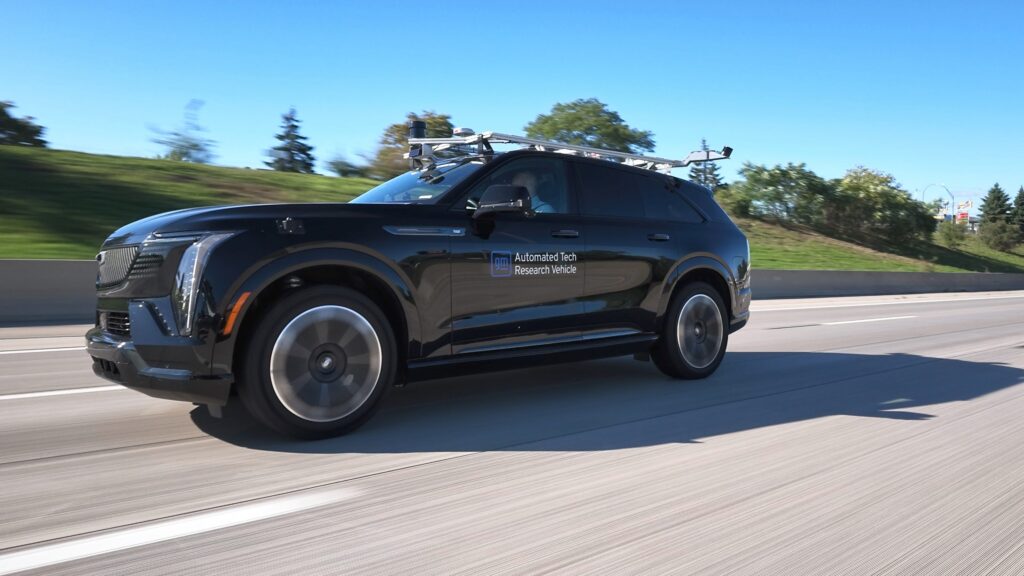
- GM today laid out an overview of how the company is using advanced technology in its future products and processes.
- The company will offer enhanced OnStar capability starting in 2027 and autonomous driving starting with the 2028 Cadillac Escalade iQ/iQL (seen in GM’s simulated image above).
- The company also said that using AI will allow it to cut development time for new cars in half.
Cars that drive themselves; virtual assistants that plan a week’s worth of meals and create grocery lists; new-car development processes that speed products to market in half the time. General Motors today gave a wide-ranging overview of how it is incorporating advanced technology into its vehicles and processes.
The first bit of new technology that customers will see is enhanced capability of GM’s OnStar telematics service. OnStar is launching an AI assistant in the 2027 Cadillac Lyriq; that capability will roll out to other models, likely the Chevy Silverado and GMC Sierra next year, and can even be retrofitted to some existing GM cars. In its fullest form, OnStar AI “transforms your car into an intelligent partner,” says CEO Mary Barra.
OnStar Expansion
As part of this effort, all of GM’s current apps will be rebranded under the OnStar umbrella next year. OnStar moves beyond the car to your mobile devices, and those of your family members that you choose to link to it. All of this would be done with the owner’s permission, of course, and GM reps that we spoke to said the company will not be selling drivers’ data to outside firms—that’s important, given how much more this enhanced OnStar will know about you. It integrates your calendar, and uses previous conversations to learn about the operator and make recommendations.
AI Promises Much Faster Vehicle Development
Chief product officer Sterling Anderson described how the company has transformed its product development using artificial intelligence. What had been a sequential process, from design to engineering to manufacturing, can be done concurrently with virtual modeling, compressing the timeline. As a result, GM claims it can shrink new-vehicle development time to just two years from concept to production. That’s down from four to five years currently.
General Motors
Easier Self-Driving, Starting with the 2028 Escalade
The company is also employing AI to bring autonomous driving on stream. GM says it will launch autonomous driving on the 2028 Cadillac Escalade iQ/iQL. GM designers are looking toward a single button to actuate autonomous driving, in contrast to today’s Super Cruise, in which the driver must initiate cruise control and then set a speed. The capability will be available first on highways, and then will expand to other roads. “Our vision is that any of our vehicles should drive itself anywhere,” said Anderson. That eventually could be without a driver at all, with the car in what Anderson called “mission mode.”
This autonomy is enabled by a new central compute platform. Lighter, simpler, and more powerful, it’s being fitted first to the 2028 Escalade iQ/iQL. GM also said to expect it in the Chevrolet Traverse/Buick Enclave/GMC Acadia; the full-size SUVs such as the Tahoe, Suburban, and GMC Yukons; and the light-duty full-size pickups. No dates were given for the new computer platform’s appearance in those models, but we’re told that the changeover doesn’t need to be tied to a major redesign; it can be part of a mid-cycle update. Eventually, the new architecture will expand to all models.
General Motors
Upgraded EV Architecture
One of the first new-vehicle platforms to fully benefit from the more advanced development process is the upcoming fourth-generation EVs. The Gen 4 EV architecture will feature new LMR (Lithium Manganese Rich) batteries that are claimed to be lower cost and 20 percent more compact yet still capable of delivering long range. GM says the vehicles on the Gen 4 architecture will be 15 percent lighter than today’s EVs and 25 percent more aerodynamic. The architecture, which GM president Mark Reuss described as underpinning “mainstream EVs,” also features more efficient electric motors and 40 percent fewer parts. Noting that EVs currently comprise a quarter of new-vehicle sales worldwide, Reuss said that percentage “is only growing.” And he added: “GM is committed to EVs for the long term. Even as we offer customers choice today.”
Related Stories
Joe Lorio has been obsessed with cars since his Matchbox days, and he got his first subscription to Car and Driver at age 11. Joe started his career at Automobile Magazine under David E. Davis Jr., and his work has also appeared on websites including Amazon Autos, Autoblog, AutoTrader, Hagerty, Hemmings, KBB, and TrueCar.
Source: www.caranddriver.com — article syndicated from the publisher’s feed; all rights remain with the original publisher.