
Schaeffler Celebrates 30 Years of Camshaft Phasing Production
Schaeffler is marking three decades of experience developing and manufacturing variable camshaft phasing systems. Volume production of the hydraulic camshaft phasing unit began at the company’s headquarters in Herzogenaurach, Germany, in 1996. Since then, Schaeffler has produced approximately 480 million camshaft phasing systems, with Hirschaid serving as the lead plant. The technology enables adjustments to valve timing based on engine requirements. It also improves the performance and torque curve of combustion engines, including those in hybrid vehicles.
“The success story of our camshaft phasing systems is a prime example of Schaeffler’s innovative strength and customer focus. The continuous development and refinement of this product group helps our customers to meet increasingly stringent requirements for fuel consumption, emissions, acoustics, and ride comfort in modern combustion engines,” says Matthias Zink, CEO Powertrain & Chassis at Schaeffler AG. “Whether as hydraulic or electric technologies – Schaeffler offers compelling solutions for different drive concepts and market requirements.”
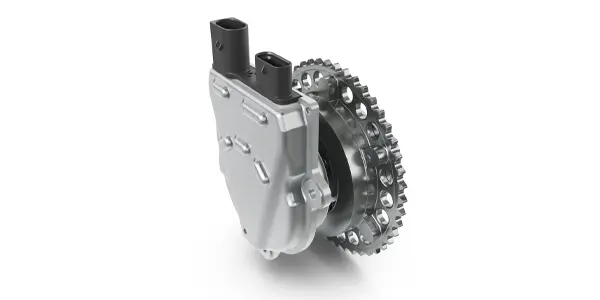
Schaeffler Hydraulic Camshaft Phasing Systems
Schaeffler’s hydraulic camshaft phasing systems use engine oil pressure to precisely adjust the camshaft position. The company uses different system architectures depending on the engine design. The technology features a robust design, high efficiency, low leakage and minimal space requirements. A locking mechanism in the home position helps ensure reliable operation during engine startup.
Variable camshaft adjustment improves the engine’s torque curve and enables lower idling speeds, fewer emissions and reduced fuel consumption.
Electric Camshaft Phasing Systems
Schaeffler has also added an electric camshaft phasing system that operates independently of engine oil pressure. The technology helps modern engines meet Euro 7 emissions standards. Its main components include a brushless DC motor, gear unit and sprocket. The modular design provides high adjustment capacity to accommodate different engines and customer requirements.
Electric phasing enables precise, rapid camshaft position adjustments under varying operating conditions. The flexible adjustment also helps optimize noise, oscillation and vibration characteristics. It can significantly reduce CO2 emissions and fuel consumption, particularly during engine startup in hybrid powertrains.
Development and Production History
Schaeffler has continually developed and optimized variable valve timing technology for more than three decades. The company began development work in 1990. In 1996, it launched volume production of its first-generation system for a four-cylinder gasoline engine in Herzogenaurach. The technology initially operated on one camshaft before expanding to both camshafts.
Beginning in the late 1990s, Schaeffler launched production programs for various European and North American vehicle and engine manufacturers. The company began manufacturing its second-generation system in Hirschaid in 2000, expanding its technological and industrial capabilities.
Hirschaid subsequently became the Schaeffler Group’s primary location for camshaft phasing system development and industrialization. The company also launched volume production of its electric camshaft phasing unit in Hirschaid in 2015.
Global Development and Production Network
“Hirschaid is Schaeffler’s lead plant for all global activities relating to camshaft phasing systems. From here, Schaeffler manages and supports related technological advancements, industrialization and international knowledge transfer within the Schaeffler Group,” says Horatiu Dan Socaciu, head of the Valvetrain Systems Business Unit at Schaeffler. “Our international network facilitates short distribution channels in the markets, close collaboration with our customers, and flexible adaptation to regional requirements.”
In addition to Hirschaid, Schaeffler operates six development and production facilities across Europe, North America, South America, China and other parts of Asia. The company plans to begin production at another plant in India in 2028.