
We Drive China’s First-Ever Super Car, And Boy Do We Have Thoughts | Review: YangWang U9
emirhankaramuk/Shutterstock
We’ve managed to get behind the wheel of just about every segment of car from China lately. From the mundane to the super-luxury and everything in between, China seems to have some sort of answer to every car segment. There is, however, one segment that Chinese carmakers have been conspicuously absent from: supercars. Until now.
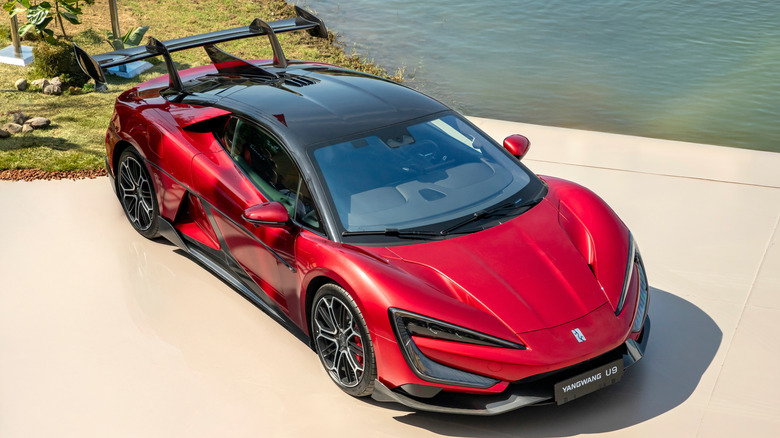
Being Chinese and from BYD, the Yangwang U9 is completely electric, and it delivers plenty of headline-grabbing numbers including its 1,288-horsepower output, its 2.3-second 0-100 kph, and its sub-eight-minute Nürburgring time. It also features 500kw fast charging, of course, with the proviso that you can actually find a charger that fast. The batteries use BYD’s Blade tech, which is their LFP chemistry, and the car runs on a 1,200-volt electrical architecture. And we got to drive it!
Our quick test was conducted at the Zhengzhou test track — a purpose-built adventure park for BYDs, which also includes low-grip skid pads, a dedicated off-road course, and the Guinness World Record-holding Sand Dune Incline test. As most new developments in China are, it’s all very new, all very shiny, and all very impressive.
The test venue — almost as impressive as the car itself
Emirhan Karamuk/Getty Images
Now when I say this was a quick test, I really mean it. We’re initially told that we’ll get two hot laps. Well, better than nothing, I tell myself. After all, this will be one of the most powerful cars I’ve got behind the wheel of. Part of the facility is a dedicated test track. It’s fairly small in the grand scheme of things, more akin to Tsukuba than Suzuka. But it has a mix of sweeping corners, tighter and technical sections, and a straight that saw us get up to around 200 km/h.
I slink myself into the figure-hugging seats, belt myself up, and instantly realize I can’t reach to close the dihedral doors. So far, so supercar. What isn’t necessarily supercar-like is the overall build quality. No squeaks, no rattles, and a fairly intuitive layout as well. It was then that I noticed there was, in fact, an electric switch for the doors, which made life easier.
The hot laps begin
TheCarPhotographer/Shutterstock
The first thing that strikes you about the U9 is just how light it feels in the first few corners. After an installation lap, the U9 feels like a sharp tool, with the suspension doing a good job of giving both a comfortable experience and providing just the right amount of dynamism to keep you engaged with what’s around you. It’s very McLaren-like in that respect, but with a bit more clinical (also known as soulless) application.
The carbon ceramic brakes, on the other hand, take some getting used to. They’re overly grabby at slow speeds — if you’ve ever been tempted to prod the brake with your left foot in a regular car with no prior experience, well, that’s the sensation you get here using your right leg. However, once you get above road-going speeds, into triple digits, they suddenly become your best friend. What were temperamental, overly eager anchors become progressive and predictable.
After my second hot lap, I realize that there’s actually some substance to the U9, particularly when the brakes start to behave. That’s when the confidence starts to build. And it’s at that precise moment we’re called into the pits to conclude our run. So, I do what any self-respecting journalist would do: I make a sad puppy-dog face and ask for just a few more laps. It takes some convincing, but they oblige. With a better baseline of familiarity, I can push the car a little more.
And push it I did
ahmad16firdaus/Shutterstock
This time I’m able to have a bit more fun. With the traction control turned down (but not off), you’re actually able to get the rear to step out. A dab of opposite lock and micro-lift is enough to get the car back in a straight line — enough to be predictable. Perhaps it was at this point I was a bit too confident in the car’s abilities. At the next corner, I’m off the brakes earlier to see just how much speed it can carry. As with most all-wheel drive platforms, you find out very abruptly with little warning when the limits of adhesion are exceeded.
The Yangwang goes into a brief, but nevertheless unnerving, four-wheel slide, the tires screaming in protest. After a snap on the wheel and a more measured application of the throttle (braking would have just compounded issues), things are back under control. But where the Disus-X suspension had hidden the sheer heft of the U9 shockingly well, as soon as the understeer came on, the laws of physics just cannot be ignored.
At 2,470 kg (about 5,500 pounds), this supercar is super-overweight. And you’d think that that’s just a fact of life for any EV these days. And while yes, you can’t get around the weight of batteries, let’s not forget that the inclusion of the hydraulic suspension system will have added a significant penalty, too. Another consideration is that the U9 uses BYD’s tried and tested Blade batteries. The Blade batteries feature LFP chemistry, which also comes at a cost to weight vs energy density, in comparison to something like a Tesla, which more commonly uses NMC.
You’ve seen this supension before
emirhankaramuk/Shutterstock
The real trick about the U9 is its DiSus-X suspension. You may have seen videos of the car being able to dance around, lifting each corner individually, and even being able to jump over small objects and potholes. It’s very reminiscent of that suspension system Bose developed in the 2000s. Bose’s system was electromagnetic, whereas the DiSus-X system features hydraulics. Both systems are more active than passive, in that they physically control the wheel, actively pushing it down to maintain composure. The Yangwang U9 takes it a step further by using sensors to scan the road ahead and uses that data to control the movement of each wheel.
While these things may sound gimmicky, there’s actually some impressive scope for real-world application, not least because the U9 is one heck of a porker, weighing in at 2,470kg. But hey, we all know that moving such mass at ridiculous velocities is technically possible. With the advent of EVs, 0-60 mph times are almost moot. What I really wanted to see was whether BYD had been able to make this supercar feel like a supercar, because combining raw figures and times with actual driver involvement is a totally different ball game.
You’re only as good as what you can control
msalbarid93/Shutterstock
But the real killer? It’s the tires. Now the U9 Extreme features some specially developed trick tires from Giti. Our car was fitted with Pirellis. Having not experienced the Gitis, I can’t say whether they fix the problem. However, the fact of the matter is, for a car this heavy and with this level of performance, it’s clear that the available rubber just isn’t able to cut the mustard.
It’s a shame, because you can tell that BYD is so close to offering a genuine supercar chal
Source: www.carscoops.com — article syndicated from the publisher’s feed; all rights remain with the original publisher.