
Flexible Metal-Organic Framework as Solid-State Battery Electrolyte
By Kyle Proffitt
October 23, 2026 | To obtain safer, higher-energy-density, long-life batteries, solid-state is widely regarded as the next step, but the best mix of compatible materials is undetermined. Particularly, replacing the liquid electrolyte with a non-flammable solid that still conducts lithium ions well is a major challenge, and several candidate solid-state electrolyte materials have been explored.
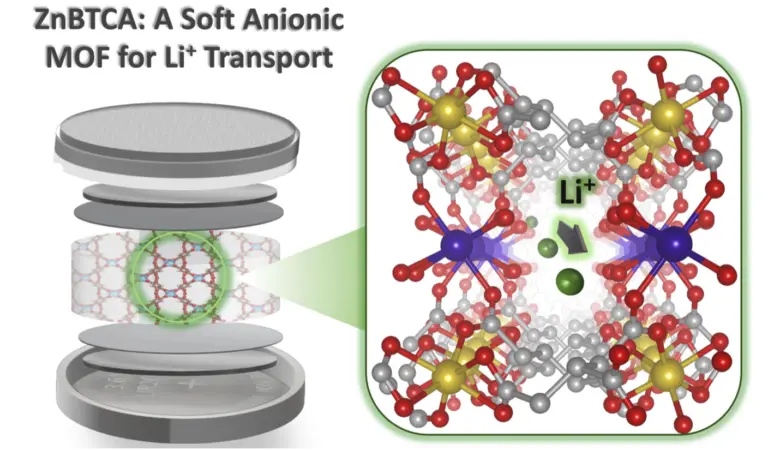
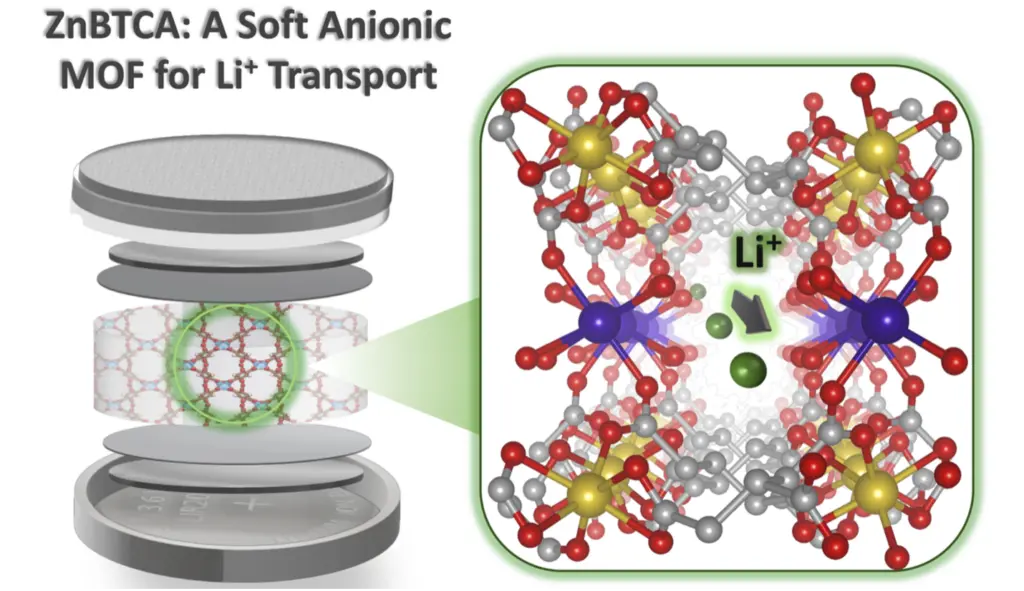
Now, researchers at Rice University report a unique metal-organic framework (MOF) as another viable option with promising characteristics. Specifically, they created a zinc-based anionic MOF that uses a flexible carbon-chain linker joining zinc atoms, giving the material a softness that promotes good interfacial contact, and they showed that it can transfer lithium ions efficiently and reproducibly. “We do not form dendrites, we have consistent cycling of the battery,” co-corresponding final author Stavroula Kampouri told Battery Power Online. The work was published August in Chemical Science (doi: 10.1039/d6sc06134f).
Metal-Organic Frameworks
Kampouri has been working with MOFs for at least a decade, as graduate student, postdoc, and now assistant professor, although the purpose has spanned light-driven catalysis, novel electronically conductive MOFs for potential use in electrocatalysis, and now, solid-state electrolytes. MOFs are a type of crystalline polymer composed of both organic components and coordinated metal atoms in repeating units, creating a two- or three-dimensional structure typically characterized by regular pores. The 2025 Nobel Prize in Chemistry was awarded for work on these molecules, for their promise in the capture, storage, and transfer of specific substances in and through the pores. “What’s exciting with MOFs is because they’re so tunable, we can think of them as a puzzle where you can change the pieces and then introduce new properties by changing the structure,” Kampouri explained. This tunability can also be directed toward the transfer of lithium ions. “We can change their properties; we can engineer them,” Kampouri added.
In the world of solid-state lithium-ion batteries, solid electrolytes are needed that enable lithium ions, but not electrons, to migrate efficiently. Ideally they also maintain stability in contact with lithium metal over wide voltage windows. Currently, some of these electrolyte options include polymers (Blue Solutions is probably the most advanced example), sulfides (including argyrodites, examples include Solid Power and Factorial), and oxides (such as lithium lanthanum zirconium oxide (LLZO), used by Ion Storage and, perhaps, QuantumScape). Each option offers distinct advantages and disadvantages for the requisite metrics.
(Re)Synthesis of an MOF as Electrolyte
Kampouri’s graduate student, Zina Deriche (with whom Battery Power Online also spoke; Deriche is co-advised by co-corresponding author Sibani Lisa Biswal), took on the project of making new MOF-based solid-state electrolytes, and “although these porous materials are ideal to transport ions, which is the goal basically of a good electrolyte,” Kampouri said, “when Zina went to the lab, she would face contact issues. There would not be sufficient contact between the electrodes and the electrolytes.”
Deriche reasoned that interface contact could be improved by making softer MOFs. “What if we make these materials [so] that they’re inherently a little bit softer and more flexible to improve the contact?” she asked. With relatively simple mixing and matching of parts in line with the design principle of MOFs, she pursued a new target. The challenge is to improve this flexibility and interface contact while preserving porosity.
“The whole goal of this project basically was to try and figure out a way to improve contact in battery materials specifically using MOFs,” Deriche explained. Many MOFs consist of aromatic linkers like terephthalic acid, which constrain linkages and increase rigidity, but Deriche synthesized a Zn MOF using an aliphatic linker (all single carbon-carbon bonds), 1,2,3,4 butanetetracarboxylic acid (BTCA), reasoning that its rotatable sp3 bonds would lend flexibility. Synthesis involves fairly simple mixing of a Zn salt with the linker and drying off solvent to grow crystals. Deriche also tried to create a negatively charged structure by performing synthesis in a basic aqueous media.
It worked. “Zina got these beautiful single crystals,” Kampouri said. But there was a surprise. “Initially we thought it was new, and then we went back and we realized that oh no, this is published actually.” They had re-synthesized a known MOF, first reported in 2008. However, this one was just a little different. The crystal structure reported in 2008 identified ZnBTCA as a neutral coordinated polymer, but Deriche’s synthesis created an anionic, negatively charged version. Where water molecules were coordinated with free zinc sites in the initial structure, some were replaced in the new structure by hydroxide anions, which were then counterbalanced by positive sodium ions. Finding tightly held sodium was a critical part of assigning some coordinating -OH groups as hydroxide ions instead of water.
In their single-crystal X-ray structure, each BTCA linker bridges six different Zn centers through its carboxylate groups. The Zn centers are coordinated two different ways; some are in contact with just two BTCA units, while others are held by four. The arrangement creates a repeating structure with tunnels through which lithium ions can pass.
To use the material in lithium-ion cells, they exchanged the sodium for lithium by soaking in LiTFSI. In the end, “we were able to synthesize an anionic MOF, which helps shuttle lithium ions much more quickly,” Deriche explained. In line with the initial hypothesis that aliphatic linkers would soften the material, they conducted nanoindentation experiments and identified ZnBTCA as “among the softer reported MOFs,” according to the paper.
ZnBTCA as Solid-State Electrolyte
Several experiments demonstrated that this form of ZnBTCA is permissive to lithium ion transport; Li+ conductivity was 3.53 x 10⁻⁵ S/cm at 20 °C and 1.87 x 10⁻⁴ S/cm at 60 °C (higher values are better). Compared with other solid-state electrolytes, this is pretty good. Typically, polymer-based electrolytes show poorer conductivity, about 10-6 S/cm, but their flexibility and relative ease of manufacture make them attractive. Additionally, polyethylene oxide (PEO), which Blue Solutions uses, can reach Li+ conductivity up to 10-3 S/cm at 60-80 °C, at which point it becomes viable for use in commercial buses. “Then you have ceramics that are even more brittle than MOFs,” Kampouri said. These are typically oxides, with conductivity of 10-3 to 10-4 S/cm. Also, Deriche said, “they’re very energy intensive … you need very high sintering temperatures to produce these very brittle ceramics,” increasing cost.
Argyrodite sulfides are a front-runner for conductivity, with ionic conductivity up to 10-2 S/cm, matching that of liquid electrolytes, but moisture sensitivity creates other manufacturing challenges.
As Shirley Meng told this year’s Solid-State Battery Summit, one of the major potential advantages of all-solid-state electrolytes is the opportunity to attain a transference number of 1, an indicator that all of the current is carried by the lithium ions, which should correspond to greatly increased cycle life. The Rice researchers explicitly measured Li+ transference in symmetric Li|ZnBTCA|Li coin cells, revealing a high value of 0.79 (significantly better than the 0.2-0.4 typical of liquid electrolytes). “MOFs could potentially combine the mechanisms for ion transport that are identified in liquid electrolytes as well as solid electrolytes,” Kampouri said.
Finally, the researchers prepared very similar symmetric cells, only adding 5% PEO to ZnBTCA as a binder, and cycled them at room temperature, increasing the current density in steps up to 1 mA/cm2. This is on the lower end but in the realm of the current density expected in a useful working cell. In total, the symmetric cell was cycled for 300 hours without any short circuit, and the voltage needed to push lithium ions through the electrolyte held steady for each cycle.
Future Work
Real, complete battery cells that can hold charge have not yet been created. With their symmetric coin cells, ZnBTCA is sandwiched between sheets of lithium metal, and the lithium must be forced through the electrolyte in both directions. No potential energy is stored.
To get to full working cells, “we would need to try different types of available cathodes, and we would need to fabricate our own cathode material in order to have a good concept of it,” Deriche said. She explained that the lab of her co-advisor Dr. Lisa Biswal specializes in anode fabrication, but they typically rely on commercial cathode materials and need more expertise in the area for further pursuit. Kampouri briefly alluded to another project in her group exploring MOFs as cathode materials, and Deriche suggested future work may tie the two projects together.
“There are many different research groups that focus more on the anodes or the cathodes, and this would definitely be something that we’ll be interested in exploring perhaps in the future—but for this particular case, it was mostly the electrolyte and analyzing its behavior, its properties, and its performance,” Kampouri said.
The project has led to an entire subgroup in Kampouri’s lab working on MOF electrolytes. “We’ve already summarized approximately ten, fifteen linkers; most of them are commercially available,” she said. “Zina is trying to tune not only the [linker] length and how this impacts both the ion transport as well as the mechanical properties—anticipating that with longer length, we should have even more flexible materials, softer materials—but also the functional group.” She gave an example. “The BTCA that she was using, it uses carboxylates as the chemical groups that are bound to the metal; we’re also exploring phosphonate, for example, and other classes.”
Deriche added, “We’re also looking at more stable metals such as zirconium and aluminum.”
Kampouri summarized the potential impact of the work. “This MOF is pretty cheap; we only have zinc, and we have a linker that is commercially available and super cheap to purchase.” Perhaps a new avenue for solid-state electrolytes has been opened. “We hope that we create this new range of solid electrolytes; they’re cheap, they’re porous, they’re abundant, and they allow for a better contact with electrodes,” Kampouri said.