
The 2027 BMW 7-Series Embraces Luxurious Maximalism
The new 7-series glides nearly silently away from a stoplight, wafting forward with a seamless acceleration unexpected for something shaped like a brutalist apartment building. “Cool,” you say. “What about the 740, the combustion version of the refreshed 7-series?” Friends, that was the combustion version. The difference between the gas-powered BMW and its electric i7 sibling is barely a whisper of pistons, the smallest shudder of stop-start. The 2027 BMW 740 and i7 are near silent in motion. But their design? That’s glittery and loud.
The 7-series is midway through its seventh generation, and like any good Hollywood star, it won’t age out without a facelift to keep it worthy of paparazzi attention. For 2027, that includes a dramatic chiseling of the exterior and a hefty investment in new materials and technology on the inside. For the 7-series, BMW invokes a Devo-like freedom of choice, with a thick binder of options for paint colors, interior materials, wheel designs, and drivetrain combinations.
BMW’s 2027 design follows a trend we’ve seen recently from other manufacturers, such as Audi and Jaguar, for sedans with blocky front ends and high hood lines. On the BMW, it’s imposing if not traditionally elegant. Its twin-bulge hood gives it the wrinkled snout of something predatory and annoyed, and if I saw one lurking in the alley, I’d think twice about crossing it.
More on the 7-series and i7
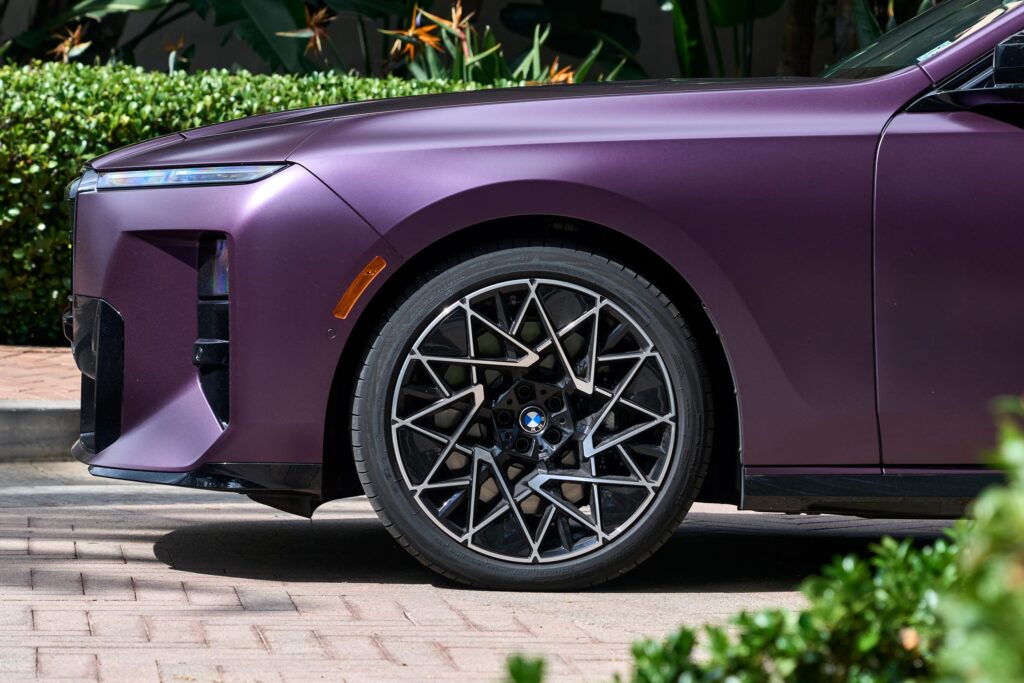
In the sunlight, though, the sedan is more friendly, sparkly even, with an available glowing grille surround and crystal headlights; optional matte and two-tone paints play up the shifting textures and reflections and make the big car look like less of a behemoth. Along the sides, the sheetmetal smooths out, becoming more upright with a high character line from nose to tail. It’s a profile that wouldn’t look out of place on one of the BMW’s Rolls-Royce brethren.
Wheel choices range from standard 20-inchers through several 21-inch multi- and cross-spoke designs. At the rear of the car, the design mimics the front, although with a less dramatic center crease in the decklid. Doubled horizontal taillights span the width in thin streaks of red, and hidden tailpipes on the gas model highlight BMW’s decision to treat combustion and electric variants as near identical twins. The recently unveiled V-8-powered M760, though, will have visible exhaust tips, as is befitting a twin-turbo 4.4-liter.
Since I’ve strayed into discussions of engines, let’s take a break from design notes to run through the powertrain options for U.S. buyers. On the combustion side, there’s the the 740: the base rear-wheel-drive turbocharged 3.0-liter inline-six with 48-volt hybrid assist, now making 394 horsepower thanks to a new turbo setup. The 740 can be had with BMW’s xDrive all-wheel drive, and BMW says the AWD version will do a 0–60-mph squirt in fewer than five seconds and top out at an electronically limited 155 mph.
The 483-hp plug-in hybrid 750e comes with xDrive standard and pairs a turbo 3.0-liter six-cylinder with an electric motor. It’s a smidgen quicker than gas alone, making the 0–60 run in about 4.6 seconds, BMW claims. We’ll also be getting the incoming twin-turbo V-8, but that wasn’t available for drives just yet.
Shoppers for all-electric machines can choose from the 449-hp i7 50 or the 536-hp i7 60; both have a two-motor, all-wheel-drive configuration. The i7 50 makes its 0–60 pass in a claimed 5.3 seconds (and is limited to a top speed of 130 mph), while the i7 60 covers the same ground in 4.6 seconds on its way to a top speed of 149 mph.
While the 740 was getting a new turbocharger, the electric models were getting a new battery configuration. The 2027 i7 uses a battery made up of cylindrical cells, first used by BMW in the iX3. This battery formation offers increased energy density, upping the usable energy capacity from 101.7 to 115.5 kWh, allowing for longer range and, BMW claims, faster charging. BMW says the i7 60 will provide a range of more than 350 miles and recharge from 10 to 80 percent in 28 minutes on a DC fast-charger.
The options continue! While there is no official M7, there are two M packages that give the 7-series a different look. The M Sport package includes additional aerodynamic elements, blacked-out trim details, M Sport brakes with blue metallic brake calipers, and a unique light signature; while the M Sport Package Professional darkens the grille glow, ups the wheel size to 21 inches, and smokes the crystal headlights.
I drove a rear-wheel-drive 740 and an i7 60 xDrive, which are close in performance, but not in price. The i7 60 I sampled would take a $150,700-size chunk out of a bank account, while the 740 could be driven away from the dealer for $139,000 (starting prices are $126,250 and $101,350). Both accelerate smoothly, with the i7 getting a slight edge due to a split second of hesitation from the 740’s stop-start before the 48-volt system kicks in to fill the gap.
BMW
Complaining about BMW’s steering feel is an international pastime, so I won’t bother here. The steering is not vibrant, but it is predictable, and on a machine like the 7-series, where the goal is to get passengers to a destination with minimal nausea, the hefty wheel and weighted turns are appropriate to the use case. The i7 60 and 740 employ a standard air suspension, adaptive dampers, and rear-wheel steering to make tight turns and lane changes both more stable and more fun than one would expect. Both cars brake well, as you should expect from four-piston front calipers and ventilated front discs (the rears are single-piston, floating calipers). The i7 60 has an advantage in pedal feel, with three settings for brake energy recuperation and an adaptive braking setting that automatically uses more regeneration for stop-and-go situations and intersections but allows for a more natural coasting effect at higher speeds and open road conditions.
Both versions of the 7-series were pleasant to drive, but the experience was less about the dynamics of the machine and more about the features and flash inside. Whatever your powertrain and add-on packages, entry to the 7-series starts with a flush-mounted door handle and opens into a cabin that needs a new vocabulary to describe its style. Let’s try “cyber-Baroque,” for its combination of quilted faux or real leathers (depending on your options sheet), faceted glass controls, and softly glowing backlit translucent plastics. Full-color projected data scrolls on the windshield, and touchscreens are embedded in the dash and door panels. Imagine if Louis XIV needed to take Zoom calls on the way to the opera. He could, because the 7-series has an in-car camera and an available massive fold-down theater screen in the back seat.
The Sun King would be reclining in comfort as he sold stocks or watched cartoons, provided he optioned the reclining rear seats and footrest. The back seats can also be equipped with a massage function (that’s standard in the front). Rainbows play over the interior from the crystal shifter and door controls. Even the glass roof is embedded with strands of light, in case the actual outdoors isn’t attractive enough.
There’s a lot going on, and despite a multiscreen interface that’s fairly navigable, the 7-series will require an adjustment period. Perhaps the most dramatic change from previous versions and competitors is learning to parse the information as it comes to you from the head-up display, the dash-wide panoramic display, the large middle screen, and the passenger’s-side screen. Better be wearing your multifocal glasses, because there’s a lot of information at different viewpoints. The car’s watching you, too, as I discover
Source: www.caranddriver.com — article syndicated from the publisher’s feed; all rights remain with the original publisher.