
Volkswagen gets L3 autonomous driving test permit in China, eyes 2027
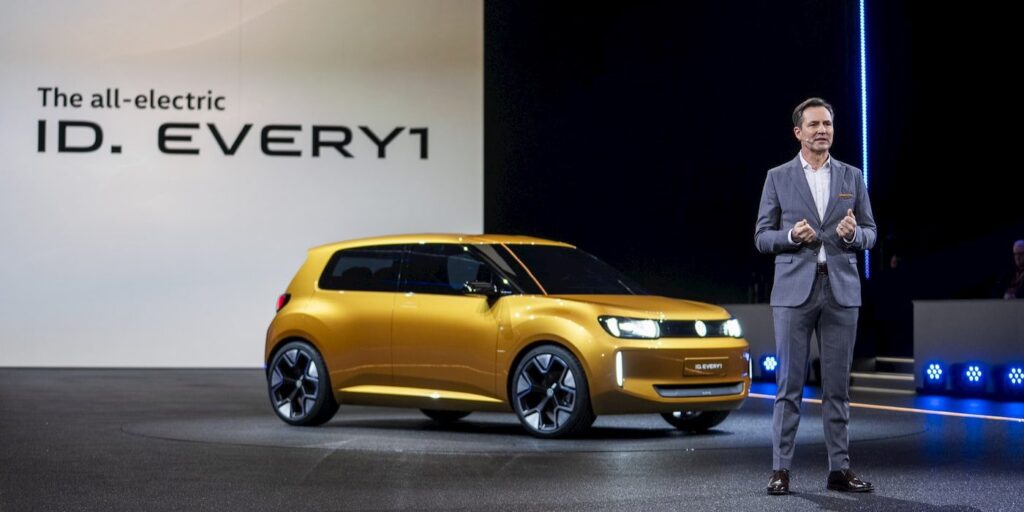
VW Brand CEO Thomas Schäfer introduces the ID. EVERY1 concept car (Source: Volkswagen)
Volkswagen Group China now has a permit to test Level 3 autonomous driving on public roads in Hefei, and it says testing is already underway. The permit also covers large-scale driving data collection in the city.
It’s the latest step toward VW’s goal of L3 technology readiness in China by 2027. And the timing is good as the group holds its first China Technology Day in Hefei on Wednesday.
VW’s China autonomy stack
VW says the permit was issued under China’s strictest L3 framework and that its setup meets the country’s latest mandatory safety design standards. It didn’t say which authority issued it, how many vehicles are in the fleet, or which roads they can use.
Hefei makes sense as a base. It’s home to the Volkswagen China Technology Company (VCTC), the group’s largest R&D center outside Germany, and to its Volkswagen Anhui production site.
Advertisement – scroll for more content
The software comes from CARIZON, VW’s intelligent driving unit in China, which started as a joint venture between CARIAD and Horizon Robotics. Its driver assistance system is called Hyper Sense 8 (HS8), which VW describes as its first “full-scenario” ADAS.
Behind it is GAIA 2.0, a world model VW built itself. VW says it runs simulation equal to 5 million km of safety testing per day, using about 30 million real-road scenario clips, and it wants to get that to 10 million km per day. VW is also developing its own system-on-chip, the C7H, which it says can support up to Level 4.
Ralf Brandstätter, chairman and CEO of Volkswagen Group China, kept the message on safety. He said the group “will never advance technology at the cost of safety” and called the permit an important step on the road to L3 readiness (our translation from Chinese).
A test permit, not a product launch
This is a road test permit. VW can’t sell L3 cars to customers with it.
China’s MIIT granted the country’s first L3 product approvals in December 2025 to two sedans: a Changan model capped at 50 km/h on designated Chongqing expressways, and a BAIC Arcfox model capped at 80 km/h on three Beijing routes. GAC’s Hyptec and XPeng already hold L3 road test permits too. So VW isn’t leading here. It’s catching up to Chinese brands on their home turf.
In July, VW, CARIZON, and Horizon Robotics said they would deepen their partnership, giving CARIZON “white-box” access to Horizon’s AI foundation model, and targeted the start of L3 deliveries in the second half of 2027. VW’s L2++ system is rolling out on seven new NEV models from its Chinese joint ventures this year.
VW also leans on XPeng in China. It bought a roughly 5% stake in XPeng in 2023 and co-developed its China zonal electrical architecture, CEA, with the startup.
Outside China, the only Western automaker with a certified L3 system on sale is Mercedes-Benz, whose Drive Pilot works on approved highways in Germany and in California and Nevada. Mercedes also got approval to test Level 4 driving in Beijing back in 2024. Tesla’s FSD remains a Level 2 system everywhere it’s sold, China included.
Electrek’s Take
L3 is where liability moves. When the system is engaged, the automaker is responsible for the driving, not the person in the seat. That’s why so few companies have shipped it, and why the ones that have keep it on a short leash: specific roads, low speeds, mostly traffic jams.
China has been serious about building a framework for automakers to bring this techonology to market, and through it, we are seeing who is interested in this version of autonomy.
Not everyone is. Many automakers, including Tesla, have been talking about “skipping” level 3 and going straight to level 4.
If you’re buying an EV, powering it with home solar can cut your fuel costs to nearly zero. With electricity rates up almost 10% last year and expected to keep climbing, going solar is one of the best ways to protect yourself against rising costs. And with lease and PPA options, you can do it with zero upfront cost and start saving immediately. If you want to find the best deal, check out EnergySage. It’s a free service with hundreds of pre-vetted installers competing for your business, so you save 20 to 30% compared to going it alone. No sales calls until you pick an installer. Get your free quotes here.
Source: electrek.co — article syndicated from the publisher’s feed; all rights remain with the original publisher.