
NHTSA Probing Ford’s Godzilla Engine For Known Cam Failures
Ford
The National Highway Traffic Safety Administration (NHTSA) is probing Ford’s big, 7.3-liter Godzilla V8 after a claim that it can suffer camshaft and lifter failures. Although there has only been one reported incident made so far, that’s apparently enough to initiate an investigation. NHTSA’s Office of Defects Investigation (ODI) received a petition on June 13, 2026, which alleges the Godzilla engine doesn’t provide adequate oil lubrication at low idle.
According to the complaint, this causes severe wear on lifter rollers and camshaft lobes, and that can trigger catastrophic engine failure and a sudden loss of power while driving. The petition also alleges that Ford is fully aware of the root cause of the fault and has released a software calibration patch that raises the idle speed to approximately 1,000 rpm in order to improve oil lubrication. Despite this, it’s claimed that Ford has not notified owners or issued a safety recall. The ball is now in the NHTSA’s court.
More than 54,000 models are being investigated
Ford
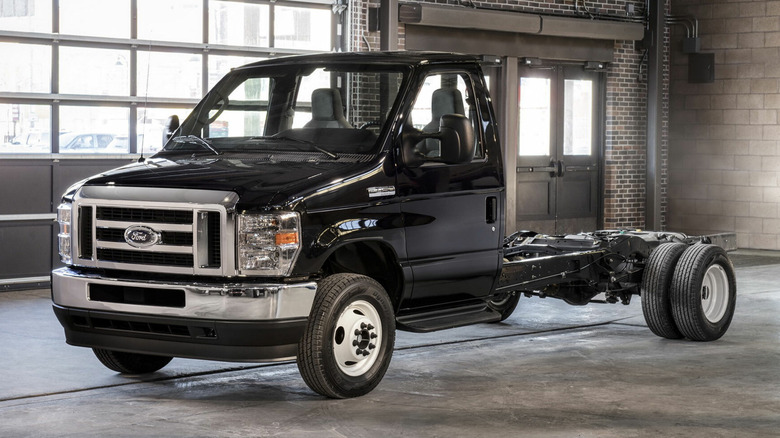
Opening a defect petition is one of the first steps the agency takes before launching a full investigation and, in some cases, forcing a car manufacturer to issue a recall. This probe includes an estimated 54,787 vehicles, consisting of 2021-2022 Ford E-350, 2021 F59, and 2021 F-750 models sold in the U.S. Several other Ford models use this same engine, but are not named. These include the Ford F-250, F-350, F-450, F-550, F-600, and F-650, as well as the F-53 chassis used for motorhomes.
Ford introduced its Godzilla family of engines in 2020 and also sells a smaller 6.8-liter version. The standard 7.3-liter model features a cast iron block, an aluminum cylinder head, and is rated at 420 horsepower and 445 pound-feet of torque in 2027 pickup truck models. Interestingly, the engine had 430 hp and 475 lb-ft during earlier model years. The reason for the drop in performance is simple. Earlier this year, Ford confirmed it had reduced horsepower and torque to meet updated environmental standards.
Source: www.carscoops.com — article syndicated from the publisher’s feed; all rights remain with the original publisher.