
Q2 Cargo Theft Incidents Fall as Losses More Than Double
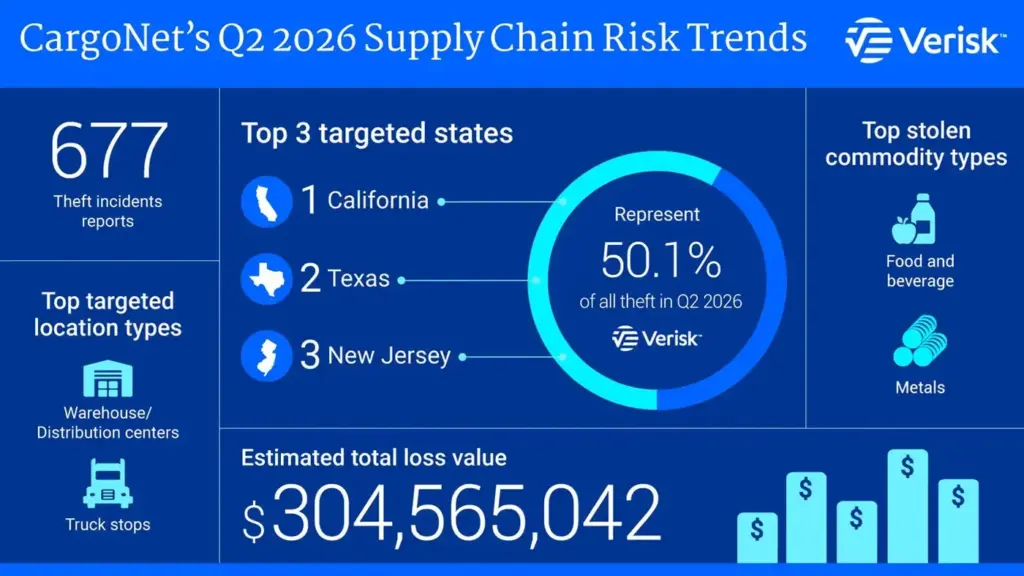
Q2 2026 cargo theft incidents fell across the U.S. and Canada, but estimated losses more than doubled to $304.6 million as high-value metals and technology shipments drove financial severity higher.
Verisk CargoNet documented 677 incidents during the second quarter, down 26% year-over-year (Y/Y) and 14% from the first quarter. Estimated losses rose from $135.7 million in Q2 2025 to $304.6 million in Q2 2026.
Among thefts with a reported commodity value, the average loss reached $564,009. CargoNet said a small number of multimillion-dollar thefts heavily influenced that figure.
“Lower incident volume should not be mistaken for lower risk,” said Keith Lewis, vice president of operations at Verisk CargoNet. “The groups driving the largest losses are not necessarily trying to steal more freight; they are trying to identify the right shipment.”
Physical Theft and Non-Delivery Fraud Decline
CargoNet said part of the decline came from fewer non-delivery schemes involving criminals who acquired existing motor carriers, booked freight under those carriers’ operating authorities, and picked up loads with no intention of delivering them.
The organization also recorded fewer organized thefts of unattended loaded trailers and ocean containers, particularly in California, Texas, South Florida, and Dallas-Fort Worth.
Incidents classified as theft declined from 488 in Q2 2025 to 378 in Q2 2026. Fictitious pickup incidents fell more modestly, from 165 to 158.
Business email compromise and shipment-misdirection activity remained comparatively steady, according to CargoNet.
Metals and Technology Drive Larger Losses
Metals moved against the broader downward trend in Q2 2026 cargo theft.
CargoNet recorded 80 metal thefts during the quarter, up from 54 a year earlier. Copper remained the most frequently targeted metal, while thefts involving aluminum, nickel, tungsten, and other industrial metals also increased.
Organized groups also continued targeting enterprise computer equipment, networking hardware, components, and cryptocurrency mining equipment.
CargoNet noted that these shipments can be worth several million dollars while moving through the supply chain as conventional dry freight.
Food and beverage theft declined overall, including fewer incidents involving beverages and mixed grocery products. Seafood theft increased by 11 incidents.
CargoNet also recorded declines in thefts involving auto parts, tires, supplements, protein products, and over-the-counter medications.
Business Email Compromise Remains a Key Threat
Business email compromise remained a primary access point for many of the quarter’s more sophisticated schemes.
CargoNet said compromised accounts can give criminals access to shipment information, contact directories, communication systems, and transportation management tools. That access can be used to identify high-value freight, impersonate trusted parties, and alter shipment instructions.
The organization said criminal groups are increasingly using access to one account to reach multiple points in the shipment process.
CargoNet expects organized groups to continue targeting metals, enterprise technology, and other high-value commodities with established resale markets while monitoring whether declines in physical theft and non-delivery schemes continue through the second half of 2026.