
Tesla Semi catches fire on I-880 with no crash, closes freeway for 10 hours
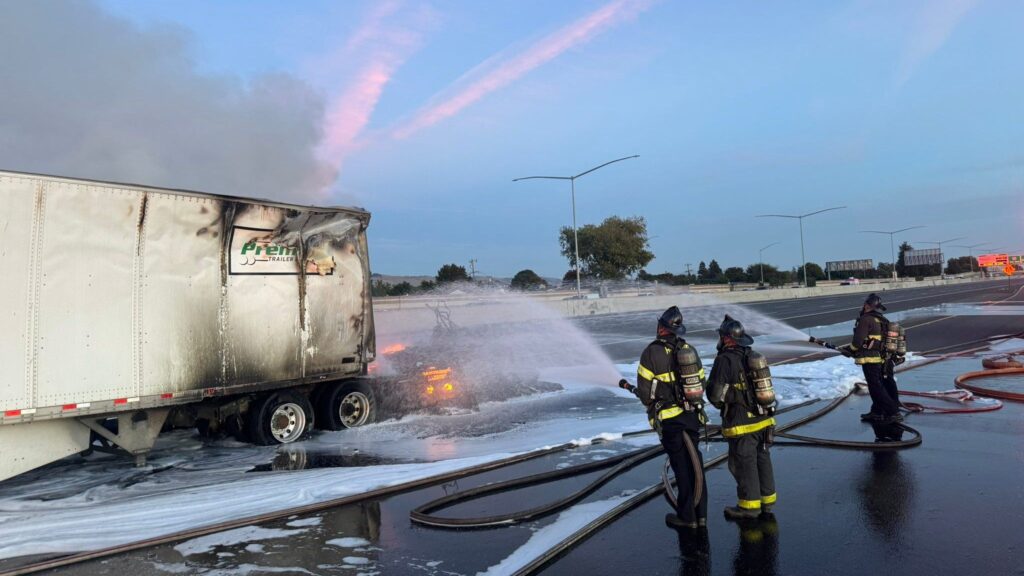
Photo: CHP Hayward
A Tesla Semi caught fire on Interstate 880 in Hayward, California, on Tuesday evening, and there was no crash. The electric truck’s lithium-ion battery burned long enough to keep the southbound freeway closed for about 10 hours.
The driver got out unhurt. But a Class 8 electric truck catching fire on its own, in traffic, is something Tesla and its growing list of Semi customers need to explain.
What happened on I-880
The fire broke out at around 5:35 p.m. PT in the southbound lanes near Route 92. CHP Hayward then closed I-880 in both directions, citing “the potential risk of hazardous chemical smoke,” and posted these photos from the scene:
🚨 TRAFFIC ALERT – I-880 FULL CLOSURE 🚨
A Tesla semi-truck has caught fire on I-880, resulting in a complete shutdown of both northbound and southbound lanes due to the potential risk of hazardous chemical smoke. pic.twitter.com/O01z32nxpZ
— CHP Hayward (@CHPHayward) October 28, 2026
The driver told officers the truck caught fire and that they didn’t know why. No other vehicles were involved.
Advertisement – scroll for more content
Northbound reopened Tuesday night. Southbound took much longer. CHP initially warned that the battery could burn for 15 to 18 hours, but crews beat that estimate, and CHP Hayward posted that all lanes were open at around 3:30 a.m. Wednesday.
The CHP photos show firefighters laying foam around the burned-out tractor, with the front of a Premier Trailer Leasing trailer charred behind it. The truck’s operator hasn’t been identified, and Tesla, which doesn’t have a press office, hasn’t commented. The cause is under investigation.
The second Semi fire to close a California interstate
We’ve been here before. In August 2024, a Tesla-operated Semi caught fire on I-80 near Emigrant Gap while driving from Livermore to Tesla’s facility in Sparks, Nevada. At the time, no crash was reported. The NTSB later found the truck had left the road on a curve, hit a delineator post and a tree, and its battery ignited after the impact. Firefighters used about 50,000 gallons of water, and the lanes stayed closed for up to 15 hours.
Hayward is different. Without a crash, the focus shifts to the truck itself: the battery pack, the high-voltage system, the drive units, or something as ordinary as a tire or brake fire that spread.
And the timing isn’t great for Tesla. The company only started volume production of the Semi in Nevada this year, after nearly a decade of delays. WattEV ordered 370 Semis in May, mostly for drayage at the Port of Oakland, just a few miles up I-880 from where Tuesday’s truck burned. In September, Tesla was also named lead supplier on a 2,500-truck ZET SCALE order.
Electrek’s Take
First, some perspective, because this fire is going to get used as an anti-EV talking point. Truck fires are common. According to NFPA data, US fire departments responded to an average of 15,462 large-truck fires per year between 2018 and 2022. That’s about 42 a day, in a fleet that’s overwhelmingly diesel. Mechanical failure was a factor in 44% of them, and only about 2% were tied to a collision.
The same goes for cars. NFPA and DOT data put the US average at one vehicle fire for every 17 million miles traveled, and combustion vehicles make up the vast majority of that fleet. Tesla claims one fire per 140 million miles for its own vehicles. That’s Tesla’s number, but independent data, like government figures we’ve covered before, points the same way: gas vehicles catch fire more often than EVs.
But that doesn’t get the Semi off the hook. Diesel fires happen across millions of trucks. Tesla doesn’t disclose Semi deliveries, but PepsiCo, its launch customer, was up to about 86 trucks in 2024, and volume production only started a few months ago. With a fleet that small, one fire with no crash is a big data point. It’s also the second Semi fire to shut down a California interstate in about two years.
So we need the cause. If a tire, a brake, or the trailer caught fire and it spread to the tractor, that’s a regular trucking problem. If the pack went into thermal runaway on its own, Tesla needs to find out why before tens of thousands of these trucks hit the road, and fire departments need a better plan than letting a loaded truck burn on a freeway for half the night.
The NTSB investigated the last one. It should look at this one too, and Tesla should publish what it finds. Will it?
Electric trucks and cars are only as clean as the electricity charging them. If you’re driving an EV, powering it with home solar can cut your fuel costs to nearly zero. With electricity rates up almost 10% last year and expected to keep climbing, going solar is one of the best ways to protect yourself against rising costs. And with lease and PPA options, you can do it with zero upfront cost and start saving immediately. If you want to find the best deal, check out EnergySage. It’s a free service with hundreds of pre-vetted installers competing for your business, so you save 20 to 30% compared to going it alone. No sales calls until you pick an installer. Get your free quotes here.
Source: electrek.co — article syndicated from the publisher’s feed; all rights remain with the original publisher.