
2027 BMW 3-Series Drive: Not Just Different but Better
You’re all thinking it. This Neue Klasse BMW 3-series is launching at the same time as the battery-powered i3, so the regular 3-series has to be compromised in some way to accommodate the all-electric version. No, it’s nothing like the 430i versus i4 situation. In that case, the platform was engineered to make it possible to fit either powertrain. With the Neue Klasse era, gas and EV each have their own platform. They’re even built at different plants. The 2027 BMW 3-series is assembled in Dingolfing, Germany, while the i3 is made in Munich.
We can therefore look at the combustion-powered 3-series primarily on its own merits. The 2027 BMW M350 xDrive and the entry-level 330 (in rear-wheel drive or xDrive all-wheel-drive configurations), which no longer have a trailing “i” attached because that’s now a prefix that means something else, can be directly compared with the outgoing M340i xDrive and 330i.
The new generation brings some minor growth: a touch more wheelbase (up 0.4 inch to 112.6), a bit more length (up 1.7 inches to 187.6), and a smidgen wider (up 0.9 inch to 72.8). It’s somewhat taller, too, but the 0.6-inch increase to 57.3 inches is mostly due to the inch-taller rolling diameter of the new standard 19- and optional 20-inch tires. A bit more concerning is the roughly 200-pound weight gain, which we estimate should put the M350 at close to 4200 pounds.
The new car looks strikingly different, as the brand’s Neue Klasse styling is in full effect. It starts with a forward-leaning grille that is spread across the front end in a low smirk, the twin kidneys stretched to credulity and blending with the headlights at the margins. It still has the long-hood proportions necessary to accommodate an inline-six-cylinder engine, with squared-off flanks that look fairly attractive in person. The hood is a bit higher and flatter, though. As before, the cabin is set rearward and blends neatly into a stubby trunk that can accommodate 16 cubic feet of goods, only a bit less than before. On the M350, the badging is a bit misleading, as the “M3” is almost twice the size of the “50.”
More on the 3-series
The two engines in the 3-series both use the Miller cycle to shorten intake-valve opening time when necessary for the optimum air-fuel ratio. They also use switchable exhaust valves to reduce engine braking so there’s more regen to be harvested by the 48-volt hybrid-assist system. In the 330, that adds up to the same 255 horsepower and 295 pound-feet we’ve seen before, but that’s still impressive because it meets Europe’s stricter emissions standards. The M350, on the other hand, gets a whole lot more. It features reshaped intake ports and combustion chambers, as well as revisions to camshaft timing, fuel injection, and exhaust-gas routing. But the new, larger turbo is the party piece that pumps up the output to 437 horses instead of the M340i’s 386. BMW says that adds up to a tenth of a second or two quicker to 60 mph (a 2023 M340i xDrive hit that mark in 3.7 seconds in our testing).
As for the chassis, there is a slightly wider front subframe, which accounts for much of the increase in front track. BMW has tweaked the links of the dual-link strut front suspension a bit, such that the caster angle is higher, and the static negative camber is down a smidge. These changes were made to improve on-center feel and effort buildup, and all we can say is “Yes, please!” Sure, at very slow parking-lot speeds the steering’s electrically assisted boost is readily apparent, but as speed builds, that quickly fades away, and a pure mechanical feel takes over. The response becomes direct and accurate, and we think BMW nailed it this time.
All 3-series models have stiffer anti-roll bar mounts, so there’s less flex, and the bar can do its work more efficiently. The rear bushings have also been optimized for their passive steering characteristics, so there’s just enough toe-in to feel secure, but not so much that the car’s playfulness is drained away. Also, the base dampers are called “lift-related” because they now have a hydraulic rebound stop instead of a rebound spring.
Unfortunately, BMW didn’t have any 330 models for us to sample. Instead, we drove the M350 xDrive on the wonderful roads of southern France; it comes standard with things that are optional on the 330. This includes the Adaptive M suspension, variable sport steering, an M Sport differential, and a strut tower brace.
The Adaptive M suspension has been retuned to be more dynamic (the Germans love that word; see also “dynamism”) while also being more comfortable. The relationship between rebound and compression damping is certainly improved, and that goes a long way toward comfort. But the roads weren’t beat up like they often are back home, so the jury is still out. BMW also monkeyed with the M Sport differential and the xDrive torque-split characteristics, so the car can now help you better hold your line even if you overcook a corner. We tried it out by entering a bend a touch hot, expecting understeer, but the M350 just didn’t seem to care.
BMW
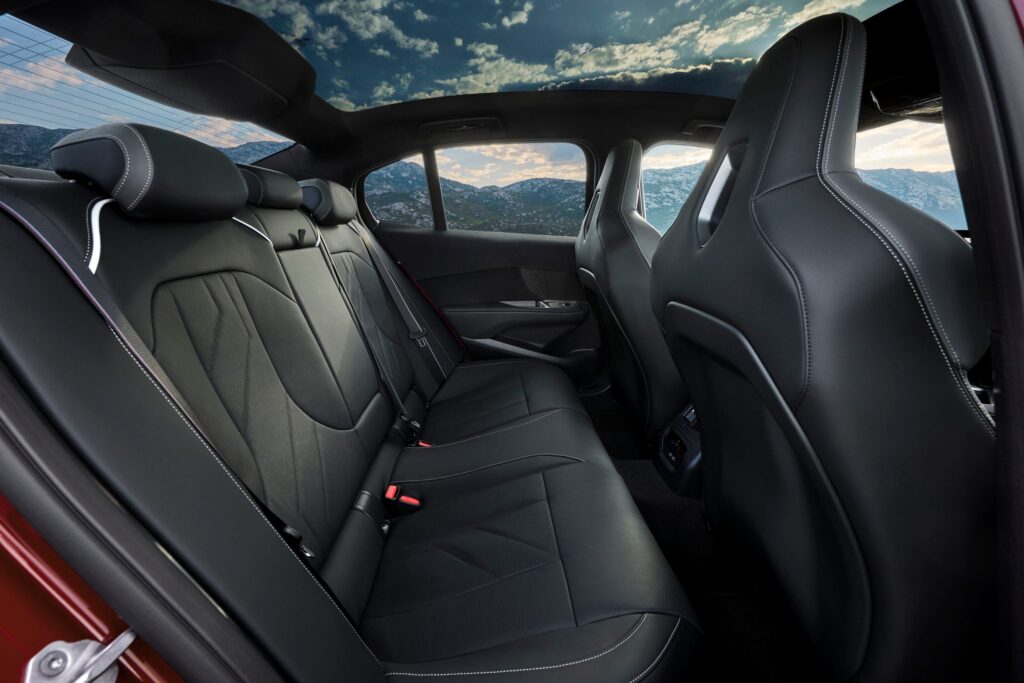
Inside, the front seats are supremely comfortable, and the rears are particularly soft. There was headroom in abundance in our car with its panoramic glass roof, but kneeroom was kind of tight for our 6-foot-2-inch tester to sit behind himself. That said, it’s certainly bigger and better back here than in the M340i. There’s a wonderful Harman/Kardon stereo too, which can play Dolby Atmos tracks on a three-dimensional soundstage. This all comes across as fantastic, but there is an elephant in the room, and it’s called Neue Klasse.
The Neue Klasse newness is most evident in the driver interface. Most of it is great, from the angled 17.9-inch touchscreen to the Panoramic Vision instrument displays projected on a blacked-out strip that spans the entire base of the windshield. But there are quirks, from the odd shape and arrangement of the spokes on the steering wheel to the presence of a (thankfully optional) head-up display. Who needs a head-up display when you have Panoramic Vision? The former projects map turn data, which you can see elsewhere, on the windshield right on top of the traffic you’re supposed to be watching. And the widgets to the right, in front of the passengers, are frankly distracting. Better to turn them off and stick with the ones directly in front of you, which, thankfully, you can do. Also, a dearth of fixed buttons makes adjusting many things, including the air vents, a trip through touchscreen submenu hell.
That said, this is a Software Defined Vehicle (SDV), so many things you want are coming soon or will be enhanced through over-the-air updates. Chief among them is something called Drift Moment, which will be pushed out to all M350 xDrive customers as soon as it passes muster. This feature diverts all power to the rear wheels with the DSC off, to basically put the car in drift mode. When it arrives, the activation button will appear alongside the already present Launch Control mode, which itself is dead simple to use. Another cool feature of this SDV is the hands-free driving mode called Highway Assistant, which works on limited-access highways at speeds up to 85 mph. It also supports automated entry-to-exit guidance and will even perform automatic lane changes when they’re confirmed by a glance in the relevant rearview mirror.
BMW
All versions of the new 3-series, and the related-but-unrelated new i3, will be released at
Source: www.caranddriver.com — article syndicated from the publisher’s feed; all rights remain with the original publisher.