
Driven: 2027 Nissan Rogue Hybrid Is the Best Nissan on Sale Today
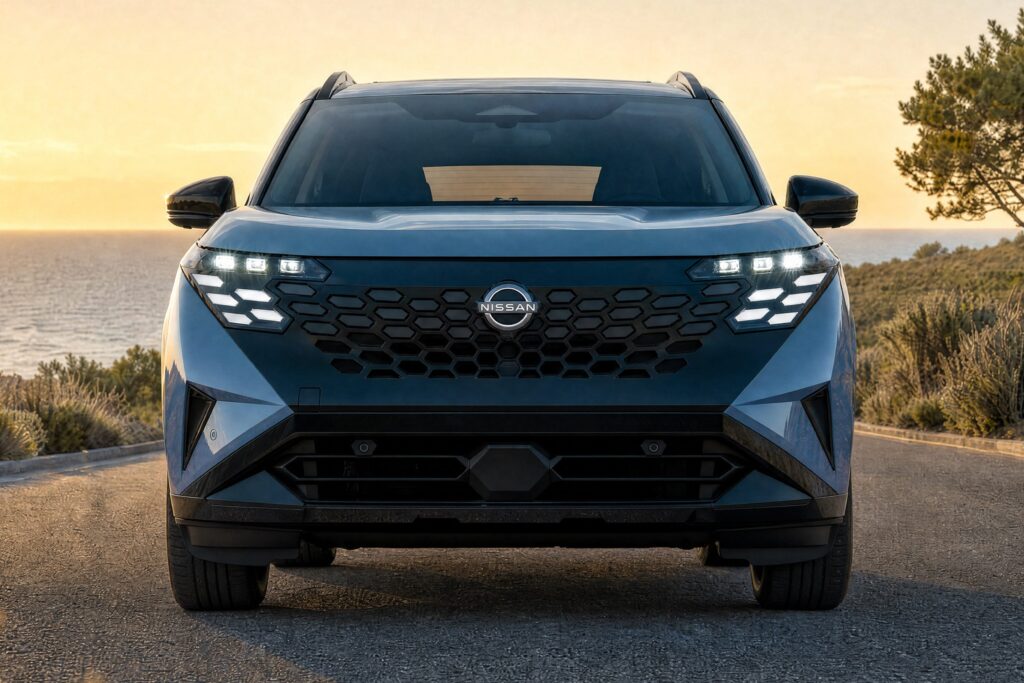
There’s confidence, and then there’s whatever Nissan is doing. The automaker is so confident in the 2027 Rogue Hybrid that it included a fleet of hybrid Toyota RAV4s for comparison. To say this is a rare event is underselling it. But, as it turns out, Toyota (and Honda) should be on high alert. This fourth-generation Rogue is quiet, comfortable, and most of all, refined in a way that punches well above the rest of the Nissan lineup.
The new Rogue Hybrid couldn’t come at a better time for Nissan. While Toyota and Honda have both been able to sell hybrid crossovers in the hundreds of thousands each year, Nissan took a different route, most recently settling for a rebadged Mitsubishi Outlander plug-in hybrid model. However, the Rogue Hybrid has a trick up its sleeve for 2027, one that we think has real legs.
Nissan
The secret behind the new Rogue’s competence is its e-Power series-hybrid powertrain. This third generation of Nissan’s multi-energy system is the first on offer in the States. The powertrain starts with a turbocharged 1.5-liter three-cylinder engine running on the Miller cycle, which serves as a generator to feed power to a compact lithium-ion battery pack. In turn, that battery sends power to a pair of electric drive motors—one on the front axle and one on the rear—giving the Rogue a full-time all-wheel-drive setup with independent motor control.
More on the Rogue Hybrid
This isn’t the same gas engine as in the brand’s other models. Nissan’s engineers told us that while the automaker does have another turbocharged 1.5-liter three-banger on the shelf, the two powerplants have little in common. For starters, the Rogue’s engine sports a larger turbocharger; one downside of bigger snails is that they take more time to spool before providing boost (and thus torque), but because the Rogue’s engine never powers the wheels, continually needing to build boost is not an issue. Nissan was able to tune the engine to spend most of its time between 2000 and 5000 rpm, which also keeps the engine’s harmonics in check and mitigates noise, vibration, and harshness.
In practice, the e-Power system is great. There are five levels of regeneration, including a true one-pedal driving mode. Thanks to the electric traction motors, Nissan developed what it calls Smooth Stop. The tech manages the final moments of deceleration to control the vehicle’s pitch and reduce any head bob when coming to a halt.
Press the right pedal, and with a combined 225 horsepower, accelerating from a stop is smooth yet perky. Nissan quotes a 60-mph time of 6.4 seconds—which would make it quicker than both the RAV4 and CR-V Hybrid—but we’ll have to wait until we can subject one to our testing regimen before we verify that figure. Even without our equipment, we can tell that the Rogue has plenty of getup. That instant e-motor torque means highway passing is a breeze. Plus, the system is zippy without giving up much in terms of fuel efficiency: The midrange SR trim earns an EPA-estimated 41 mpg city, 36 highway, and 38 combined; the SV and Platinum trims are down 1 mpg on the highway and in their combined ratings, making the Rogue not quite a class leader but not too far off either.
On the curvy roads surrounding Santa Barbara, California, the Rogue handled itself well. The steering is a bit lifeless, but it’s no worse than the rest of the segment. Hustle the Rogue through a particularly tight curve, and the rear-axle torque vectoring will keep understeer to a minimum. We’re hesitant to speak too favorably of the Rogue’s ride quality, given the dearth of broken pavement we traversed, but we came away with no real grievances against the crossover’s suspension and high hopes for its composure over the poorly maintained roads around our home office.
The Rogue’s new interior is less impressive than its powertrain and driving demeanor, but we’ve got little to complain about. Nissan did a good job of hiding any cost-cutting here. Faux leather on the seats might be an expectation, but in here, the material extends to the door trim, center console, dashboard, and even the side of the central tunnel. Also, card-carrying members of the Piano Black Haters Club will appreciate a total lack of fingerprint magnets. The cabin is also a practical space, with up to 66 cubic feet of storage when the second row is folded down. Parents will appreciate that the rear doors open nearly 90 degrees, giving plenty of room to install or remove a car seat.
The base SV and mid-level SR trims come with a 12.3-inch touchscreen setup, though the SR model we drove was optioned with a 14.3-inch unit (standard on the Platinum) running a Google-based OS with support for wireless Apple CarPlay and Android Auto. The resolution is crisp, and the screen is plenty responsive, but our favorite part of the cockpit is situated below the displays. There, Nissan equipped the new Rogue with dedicated physical controls for the heated and cooled seats, temperature, fan speed, and climate-control modes. The wireless phone charger located at the front of the center console includes magnets, and they work wonders to prevent your phone from sliding around like a greased pig (the Platinum trim gets dual wireless phone chargers). While we will never hate on the presence of switchgear, we do wish the array felt a bit nicer to manipulate.
We found the Rogue’s seats plenty comfortable, even after a full day of driving. Wind and tire noise are hushed, allowing for quiet conversations while keeping driving fatigue to a minimum. Still, for as mitigated as they are, wind and tire noise are more prevalent in the cabin than engine noise, which is seemingly kept under lock and key about two towns over. There’s so little engine NVH that most passengers shouldn’t notice when the turbo three-pot kicks on to power the battery.
The Rogue Hybrid is priced attractively too. Since Nissan wants the next-generation nonhybrid Rogue to serve as the model’s entry point, there’s no generic S trim for the hybrid. Instead, the electrified Rogue lineup starts at $37,065 with the SV variant. The SR (the trim we drove) will be the first trim to arrive and will start at $39,065. The SV and the $45,065 Platinum won’t arrive until January.
Nissan
There’s no doubt about it: The 2027 Nissan Rogue Hybrid isn’t just the most compelling product in Nissan’s lineup; it’s compelling, period. You’ll notice we didn’t even bother talking about the Toyota that sat right next to it.
➡️ Skip the lot. Let Car and Driver help you find your next car.
Specifications
Specifications
2027 Nissan Rogue Hybrid
Vehicle Type: front-engine, front- and rear-motor, all-wheel-drive, 5-passenger, 4-door wagon
PRICE
Base: SV AWD, $37,065; SR AWD, $39,065; Platinum AWD, $45,065
POWERTRAIN
turbocharged and intercooled DOHC 12-valve Miller-cycle 1.5-liter inline-3, 148 hp, 171 lb-ft + 2 AC motors, 202 and 134 hp, 243 and 144 lb-ft (combined output: 225 hp; lithium-ion battery pack)
Transmissions, F/R: direct drive/direct-drive
DIMENSIONS
Wheelbase: 106.5 in
Length: 183.1 in
Width: 72.8 in
Height: 67.7 in
Passenger Volume, F/R: 54–56/45–47 ft3
Cargo Volume, Behind F/R: 66/34 ft3
Curb Weight (C/D est): 4100–4200 lb
PERFORMANCE (C/D EST)
60 mph: 6.3 sec
1/4-Mile: 15.5 sec
Top Speed: 110 mph
EPA FUEL ECONOMY (C/D</e
Source: www.caranddriver.com — article syndicated from the publisher’s feed; all rights remain with the original publisher.