
Are Kia And Hyundai’s Engines The Same?
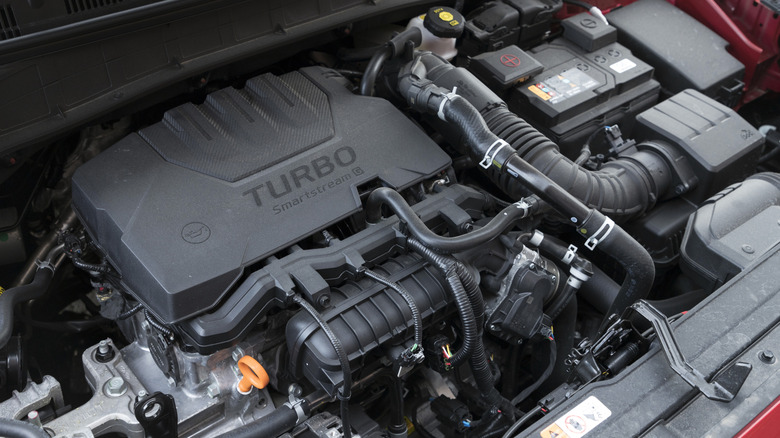
Across the board, these two automakers have a lot in common
Emirhan Karamuk/Getty Images
The relationship between Hyundai and Kia today is not what it was like in the past. Kia was founded in 1944, while Hyundai was formed in 1967. It was only after Kia declared bankruptcy in 1997 that its South Korean rival stepped in and bought a 51% stake. Now, Kia and Hyundai are like two peas in a pod, sharing technologies, architectures, and engines.
A slew of engines are shared between Hyundai and Kia. One notable example is the turbodiesel 2.2-liter CRDi inline-4 that’s been available in the Hyundai Santa Fe and Kia Sorento since 2009. It’s built at Hyundai’s factory in South Korea and is generally regarded as a solid, reliable engine, though issues with the piezo-electronic injectors can cause it to run poorly and necessitate expensive repairs. The 2.2-liter CRDi is also known to sometimes suffer from high oil consumption, potentially sipping up to 0.5 liters per 600 miles. Beyond the Santa Fe and Sorento, this engine is also found in the Hyundai Palisade, Hyundai Sonata, and Kia Carnival.
Another noteworthy engine used across several Hyundai and Kia models is the Smartstream turbocharged 2.0-liter inline-4, sold in the likes of the Santa Fe, Sonata, and K5, though it’s mostly found in Asian markets. Related to this engine is the Smartstream turbocharged 2.5-liter inline-4. It powers the Hyundai Sonata N Line, Kia Sorento, and several Genesis models. According to reports, this engine may also power the next-generation Hyundai N cars.
Hyundai builds some of its engines in the United States
Jonathan Weiss/Shutterstock
The two brands share a turbocharged 3.5-liter V6, known as the Smartstream G3.5, while Hyundai also builds a twin-turbo version for the Genesis brand. Sharing engines makes sense for the companies, as they can split development and manufacturing costs without the need to establish dedicated supply chains. Many of these shared Hyundai engines are manufactured right here in the United States. The list includes the Smartstream G2.5GDi and T-GDi engines, as well as the G1.6 T-GDi, and G2.0 Atkinson.
If you buy a Hyundai or Kia model, such as the Kia Telluride or Sportage, or perhaps a Hyundai Tucson, Santa Cruz, or Santa Fe built in the U.S., there’s a good chance it’ll have a homegrown engine. For the most part, American buyers can rest easy knowing their new Hyundai or Kia should have a reliable engine, and if something does go wrong, all are covered by a standard 10-year/100,000-mile warranty. While most engines the brand currently uses are solid, some have had issues in the past.
Common issues and complaints
RMT51/Shutterstock
Two of the most notable engines with issues are the 1.8-liter and 2.0-liter inline-4 Nu mills, and the 1.8-liter, 2.0-liter, and 2.4-liter Theta II inline-4 units. These engines have been the subject of several recalls and a large class-action lawsuit with Kia and Hyundai in the United States over reports that they can stall, seize, and catch fire. In 2024, the automakers agreed to settle the lawsuit, providing cash rebates for affected owners and extending engine warranties to 15 years or 150,000 miles.
The downside of engine sharing between Hyundai and Kia is that if an engine family has issues, several vehicles from both brands are likely to be affected. In this case, the Nu and Theta II issues impacted models included the 2011-2015 Hyundai Sonata Hybrid and 2014-2021 Hyundai Tucson, along with the 2011-2016 Kia Optima Hybrid and 2011-2013 Kia Sportage models, among others. It’s worth noting that the parts sharing between Hyundai and Kia extends beyond the engines.
Hyundai and Kia’s EVs also have a lot in common
emirhankaramuk/Shutterstock
Many EVs built by the two brands also share components. This includes the Kia EV6, Hyundai Ioniq 5 and Ioniq 9, and Genesis GV60 — all of which use the 800-volt E-GMP platform with shared battery packs and electric motors. The Hyundai Ioniq 3 and Kia EV4 use a 400-volt version of this architecture.
Like the Nu and Theta II engines, these electric powertrains haven’t been without fault. Several EVs using common parts have experienced Integrated Charging Control Unit (ICCU) problems. If the ICCU fails, the EV essentially becomes useless. Hyundai and Kia have faced lawsuits over these failures, and they have issued recalls. Hyundai has also been forced to extend warranty coverage of impacted models to 15 years/180,000 miles.
For many Hyundai and Kia models, the real differences come down to the exterior design and interior layouts. If you don’t like the somewhat controversial design of the current Hyundai Santa Fe, then perhaps the related Kia Sorento is a better option. Or, if the Kia EV6 looks a little strange to you and you prefer the retro feel of the Hyundai Ioniq 5, then it may be the EV for you.
Source: www.carscoops.com — article syndicated from the publisher’s feed; all rights remain with the original publisher.