
The Carbon Body Is The Least Interesting Thing About This Ford Mustang
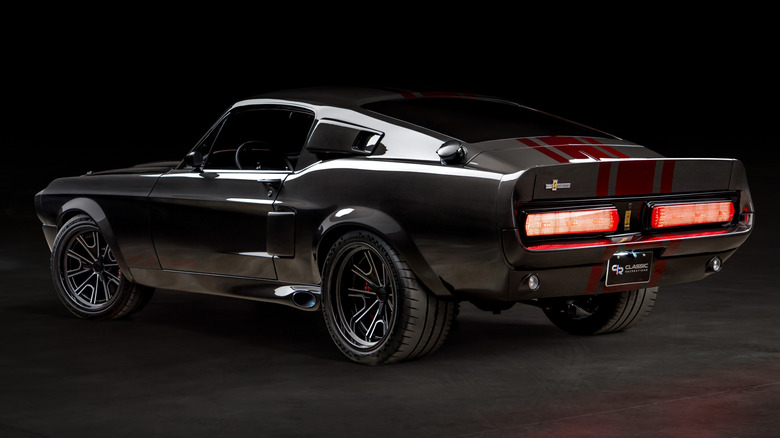
This 1,000-hp beast will be parked at SEMA in the FuelTech booth
Classic Recreations
The McLaren MP4/1 of the 1981 F1 season was the first car to use carbon fiber extensively in its construction, and it wasn’t until 1990 that the Jaguar XJR-15 became the first road-legal car made entirely from carbon, including the chassis and bodywork. The world now has an all-carbon-fiber-clad 1967 Ford Mustang Shelby GT500 courtesy of Classic Recreations, bringing a modern material to a car that predates its automotive use by more than a decade. Yet, there’s more to this GT500 than carbon fiber.
Unveiled at SEMA, this is one of the first cars Classic Recreations has built since Velocity Restorations took over last year. Dubbed the Shelby GT500CR, it is the only carbon-fiber Mustang of its kind officially licensed by Shelby. The carbon looks absolutely astonishing, covering every exterior panel and contrasted with red-tinted carbon fiber racing stripes.
Classic Recreations has built several carbon fiber-clad Ford Mustangs before, with several selling for in excess of $500,000. The company unexpectedly filed for Chapter 11 bankruptcy last July, citing between $1,001,000 and $10 million in outstanding liabilities. Florida-based restomod builder Velocity Restorations acquired and saved it last November and locked in a new licensing deal with Shelby to keep building these cars. While we sometimes get bored of the dizzying array of restomods hitting the market, we’ll never get tired of seeing classic Mustangs fitted with modern powertrains like this.
It’s what’s on the inside that really counts
Classic Recreations
For as impressive as the carbon fiber skin is, this Mustang’s engine is the real headline. It’s driven by a modified Coyote 5.0-liter V8 with a 3.0-liter Whipple supercharger and a standalone FuelTech GT700 ECU. The V8 is rated at a monstrous 1,000 horsepower and drives the rear wheels through a 9-inch Ford rear end, a carbon fiber driveshaft, and a 10-speed automatic transmission. A traction control system has been added, giving it a chance to put the power to the ground.
The modifications don’t stop with the new bodywork and engine. The car includes new front and rear suspension systems, Nitron electronically controlled shocks, and a stainless-steel fuel tank. It sits on bespoke Forgeline wheels with Michelin Pilot Sport Cup 2 tires and also includes a stainless exhaust. Perhaps the most interesting and surprising upgrade is on the braking front. Positioned at both the front and rear are 14.9-inch (380 mm) carbon-ceramic discs, working alongside six-piston front calipers and four-piston rear calipers. This should give the car more than enough braking performance to match the 1,000 hp brute of an engine.
Classic Recreations
The car’s interior has also been tweaked. It includes a Vintage Air air conditioning system, a Dakota Digital cluster, new floor mats, custom seats, and an Ididit steering column. Some carbon fiber has been added to the transmission tunnel for that extra exotic feel, and a new Alpine head unit has been included. If the owner wants to listen to their favorite tunes, new Focal K2 speakers have been fitted alongside a Mosconi amplifier. However, if we had to pick between listening to music or enjoying the supercharged V8 to its fullest, it’d be that raging Coyote.
Source: www.carscoops.com — article syndicated from the publisher’s feed; all rights remain with the original publisher.