
Mercedes’ Smart Rear Window Delivers Passive Aggressive Messages To The People Behind You
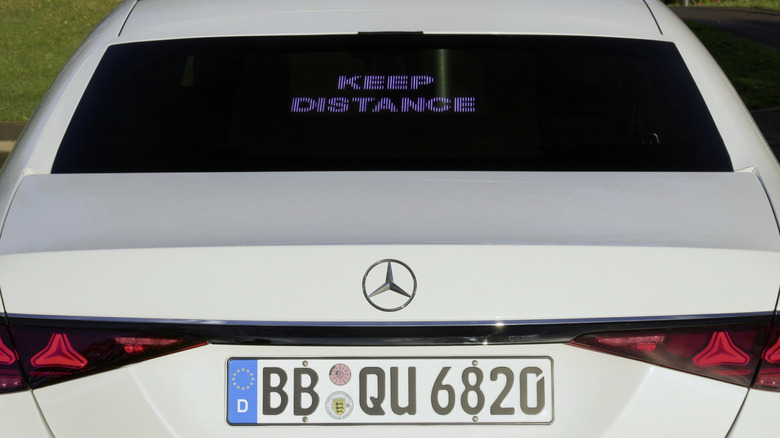
What could go wrong here?
Americans have been sending messages to the drivers behind them ever since Forest P. Gill turned a load of self-adhesive paper into the first bumper sticker in 1946. But now Mercedes wants to give the bumper sticker a digital update by allowing you to turn your rear window into a pixelated message board.
Mini LEDs embedded in the rear window light up when needed to create the messages, and they are invisible the rest of the time so as not to spoil the driver’s view of what’s going on behind him. This being Mercedes, the messages are not in the realm of “Why don’t you act like your hairline and take a few steps back” or “My other car is a Mercedes.” They’re sensible, safety-focused, and hilariously passive aggressive.
Someone blasting you from behind with their high beams? Show them the headlight symbol with a massive red line through it. Tailgater trouble? The “keep distance” message kindly suggests that back off a little. Other worthy possibilities include warnings of a pedestrian crossing or a crash ahead, or a signal that the car in front of them is about to back into a parking bay.
These are the officially sanctioned messages. Mercedes makes no mention of drivers being allowed to come up with their own, and probably for good reason. But you just know that it’ll take about five minutes after this tech hits the streets for some enterprising coder to hack the system and deliver digital abuse to any following BMW, Audi or Lexus.
What else is Mercedes cooking up?
Mercedes’ engineers haven’t only been working out how to display messages on the rear window. They’ve been busy with the side windows and windshield, too, though the LEDs involved are understandably much smaller. We’ve had head-up displays for over 20 years, but instead of limiting displays to a small area in front of the driver, Mercedes wants to turn a large area of windshield into a giant communication surface. A projector in the top of the dashboard beams content upwards, and a transparent film laminated into the glass reflects the projected wavelengths using “holographic optical elements” (HOE). Hyundai showed something similar last year.
The light is bundled in such a way that the image can be seen in all conditions, including bright sunlight. But the clever part is that anything projected onto the passenger side of the glass can’t be viewed by the driver, and vice versa. Which means passengers can watch videos and movies while the car is in motion. Whether they will, is another matter. Automakers have been pushing expensive passenger-side digital dashboard screens for the past few years, which you’d think would give a better viewing experience than this new projected tech, but one study found that they’re rarely used.
Mercedes says other uses beyond entertainment include video calls and displaying points of interest along your route. That’s likely to become a big deal in the years to come as businesses like restaurants, hotels and tourist attractions pay to appear as stop-off suggestions in cars from all brands. No timeframe was given for the tech’s introduction, but if Mercedes is showing it, it must have production intent. Our guess is you’ll be able to digitally tut-tut at the driver behind you before the end of the decade.
Source: www.carscoops.com — article syndicated from the publisher’s feed; all rights remain with the original publisher.