
Subaru AVH Explained: What It Means And How It Works
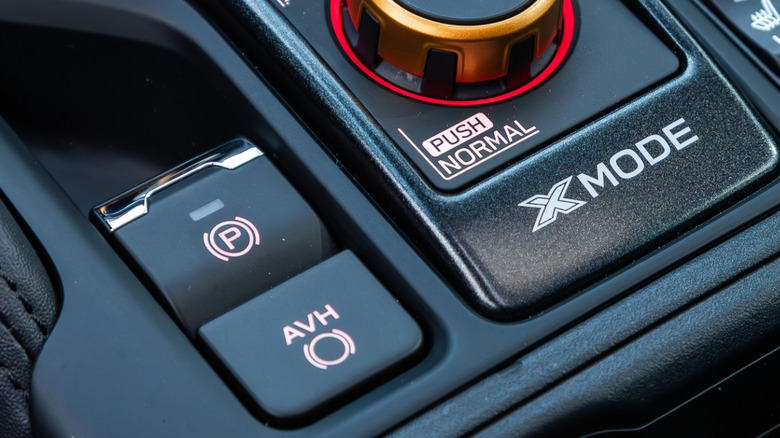
That mysterious button near the shifter could give your right foot a break in traffic.
Everyonephoto Studio/Shutterstock
Automatic transmissions help take the stress and strain out of traffic jams by removing a clutch pedal from the driving equation. But that only gives your left leg a rest. Your right still has to do the stop-go stuff, and pressing down on the brake pedal intermittently for an hour can get pretty tiring. You could keep throwing your automatic transmission shifter into park, and back to drive, every time traffic starts to creep forward, but Subaru’s AVH is a much neater solution, one that some drivers don’t even know they already have.
AVH stands for Auto Vehicle Hold, and if you do own a Subaru built for MY18 or later, you might have noticed a button marked AVH on the console, or on the touchscreen, and wondered what it does. It’s a feature that automatically holds the brake pressure once you’ve come to a stop, even after you’ve taken your foot from the brake pedal.
You might have already driven a car with a hill-start assist feature, which keeps the brakes on for a couple of seconds when you go to pull away on a hill. AVH is similar, but it works even on flat ground, and keeps the brakes on until you are ready to drive away. Subaru isn’t the only automaker to offer this kind of brake hold feature. BMW, Audi, Mini, Honda, and Ford have similar systems. So do Porsche and Mercedes, but those two German brands require you to press the brake very firmly after you have initially stopped to engage the system. Subaru’s AVH activates the moment you come to a halt, and disengages as soon as you press the accelerator to move off.
How to use AVH
AVH is fitted to most new Subarus, including fully electric cars like the Solterra EV, but there are a few exceptions. It’s not present on any cars with manual transmissions, like the stick-shift WRX, or on any BRZ coupe, regardless of the number of pedals in the footwell.
But if your Subaru does have AVH, you need to switch it on before you can use it. That switch is located either on the console, or in the touchscreen, depending on model, and once pressed, will illuminate an AVH symbol on your dashboard gauge cluster. Now your Subaru will stay stopped even if you release the brake pedal, which we’ll admit can feel a little unnerving the first time you try it.
To release the brakes, simply press the accelerator and the car drives smoothly away. Stop again, and it re-engages, although the system does fully deactivate once you unbuckle your seatbelt, open the driver’s door, or switch off the engine. That means you have to go through the button-pressing routine every time you get in the car.
Some drivers who really appreciate AVH might prefer it to activate automatically on startup — as was the case for Ascent crossovers built before the MY23 update — but drivers of current Subaru models will have to train their muscle memory until they reach for the switch without thinking.
Want to really give your right leg a rest? Adaptive Cruise Control, part of Subaru’s EyeSight driver assist bundle, can maintain a safe gap to the car ahead in ebb-and-flow traffic, and bring your car to a complete stop when needed without you touching the brake pedal. A tap on the gas then gets you rolling again when traffic ahead moves off.
Source: www.carscoops.com — article syndicated from the publisher’s feed; all rights remain with the original publisher.