
Bill Hanvey and Emily Poladian Discuss Aftermarket Growth Outlook
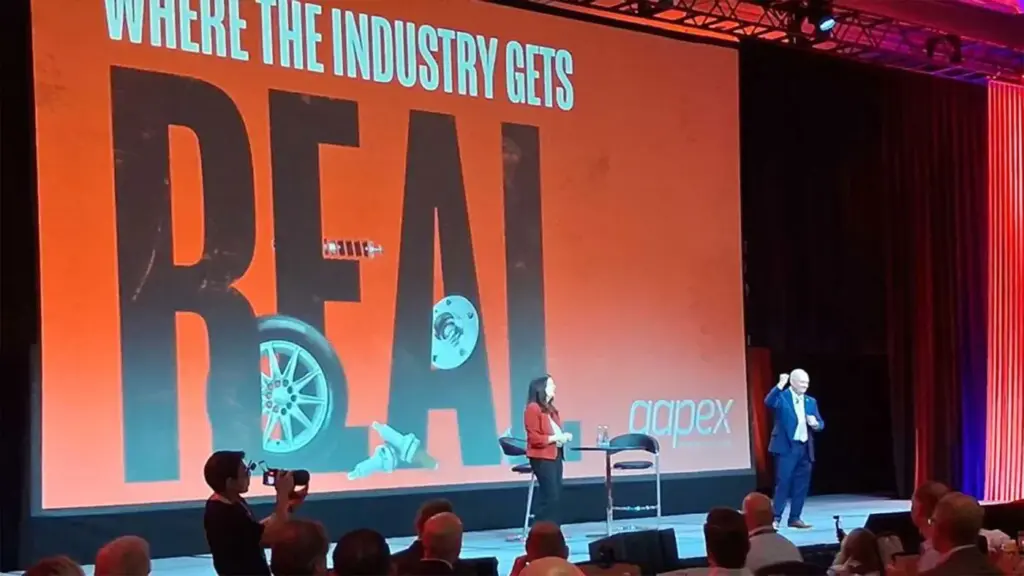
The U.S. light-duty aftermarket is projected to grow 5.2% in 2026 and exceed $500 billion, but serving that demand requires companies to keep pace with changing vehicles, customer expectations and the technology reshaping their own operations.
That was a central message from Auto Care Association President and CEO Bill Hanvey and MEMA Aftermarket Suppliers President Emily Poladian at AAPEX, where they connected the industry’s growth outlook with the work required to develop replacement parts, move them through distribution and support the technicians who install them.
Hanvey cited the 2026 joint channel forecast as evidence of an industry that remains fundamentally strong. Both speakers pointed to speed, choice, innovation and adaptability as reasons consumers continue to choose independent aftermarket businesses.
“We learn fast, we build fast, we respond fast,” Hanvey said.
That response starts well before a vehicle enters a service bay. Vehicle manufacturers begin with engineering information, service procedures, tools and years of development. Independent aftermarket companies must understand the technology, engineer replacement products, build catalog data and develop diagnostic tools. Technician training and distribution must follow.
For manufacturers, distributors and repair businesses, the speakers described opportunities to use technology throughout that process. Artificial intelligence can support forecasting, decision-making and predictive analytics. Additive manufacturing can accelerate parts development and production. E-commerce, automation and supply chain technology can help products and information move faster.
The operational goal is to better understand demand, manage complexity and get the right parts and information to customers. That places business technology alongside the vehicle technologies already changing what the aftermarket makes, sells and services, including electrification, software and connectivity.
“When the vehicle changes, we change with it,” Poladian said.
Access to repair information remains part of that challenge. Hanvey said the industry’s right-to-repair objectives continue to center on consumer choice, fair competition and the independent aftermarket’s ability to service increasingly sophisticated vehicles.
The program recognized Rep. Dunn’s work on the REPAIR Act, including his efforts to bring stakeholders together around the issue. Hanvey and Poladian emphasized that the industry must remain willing to adjust its approach while pursuing those objectives.
Workforce development was another priority. The speakers highlighted scholarships, industry networks and programs that help people find technical, operational, analytical and entrepreneurial careers. They also discussed changes to the University of the Aftermarket’s Leadership 2.0 program informed by industry focus groups.