Electric cars are about to overtake petrol in the UK, data shows
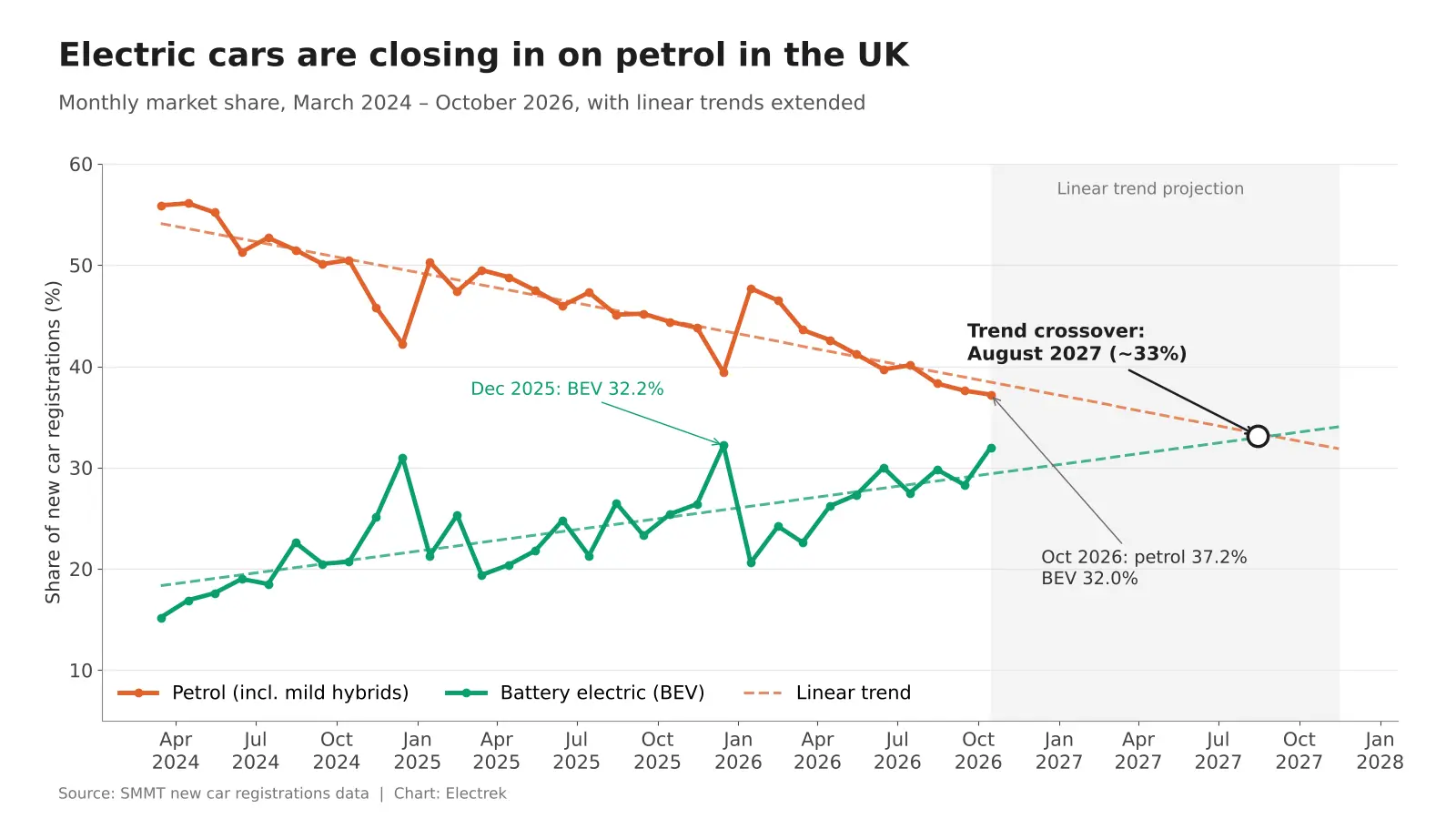
Battery-electric cars took 32% of the UK’s new car market in October, while petrol cars fell to just 37.2%, according to new data from the SMMT. That’s the closest the two have been.
At the current pace, electric cars will outsell petrol in the UK within a year. And it could happen as soon as this December.
October: EVs up 33%, petrol down 12%
The UK registered 152,730 new cars in October, up 5.4% year-over-year and the 11th straight month of growth for the overall market.
All of that growth came from plug-ins. BEV registrations jumped 32.7% to 48,858 units, and plug-in hybrids rose 30.1% to 22,898. Meanwhile, petrol fell 11.6% to 56,876 units, diesel dropped 15.9%, and even conventional hybrids were down 5%.
Through the first 10 months of the year, the UK has now registered 503,805 BEVs, up 30.4%, for a 26.6% market share. Petrol’s year-to-date share is down to 41.1%, from 47.2% at the same point last year.
The trend points to 2027, or sooner
We pulled SMMT’s monthly fuel-type data going back to March 2024 to see where this is heading. Note that SMMT counts mild hybrids as petrol (or diesel) in its headline categories, and that’s generally how we count them at Electrek.
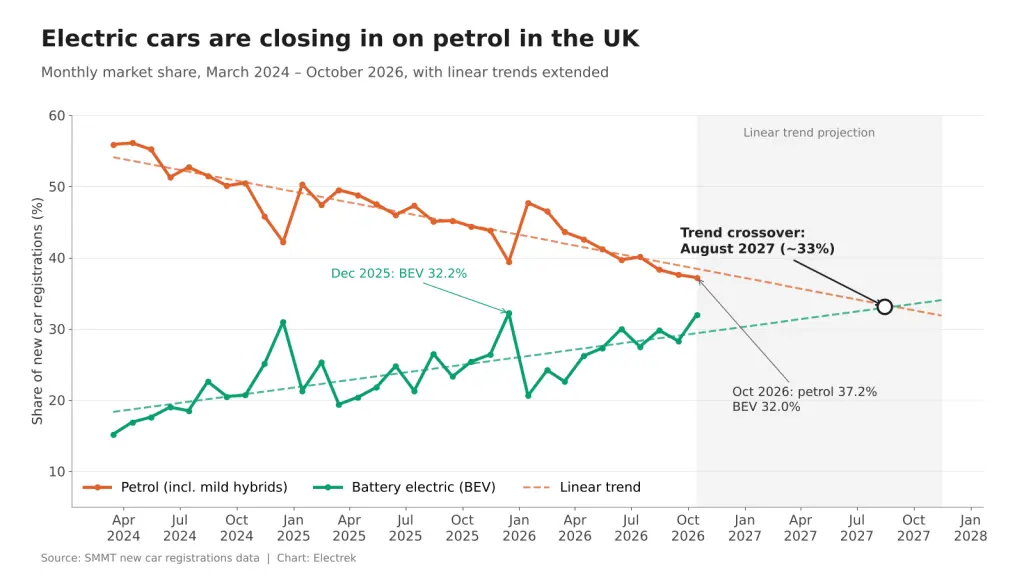
In March 2024, petrol held 55.9% of the market and BEVs 15.2%. In October 2026, it was 37.2% vs 32.0%. Petrol’s share is shrinking by about half a point per month on a linear trend, while BEVs gain about 0.36 points a month. Extend both lines and they cross around August 2027 at roughly 33% each.
But that’s the slow scenario, because it ignores December.
UK BEV share spikes every December as automakers push volume to get closer to their ZEV Mandate targets. BEVs hit 31.0% in December 2024 and 32.2% in December 2025, when petrol was at 39.4%. Over the last five months, BEV share has run about 5 points higher than a year earlier, and petrol about 7 points lower. If December follows that pattern, BEVs land around 37% and petrol around 32%.
That would be the first time BEVs beat petrol in SMMT’s headline numbers, mild hybrids included.
However, SMMT’s own forecast of 27.2% BEV share for the full year implies roughly 31% for November and December combined, which would make it a much closer call. And on a stricter definition that puts mild hybrids with hybrids instead of petrol, BEVs already outsold every other powertrain in August.
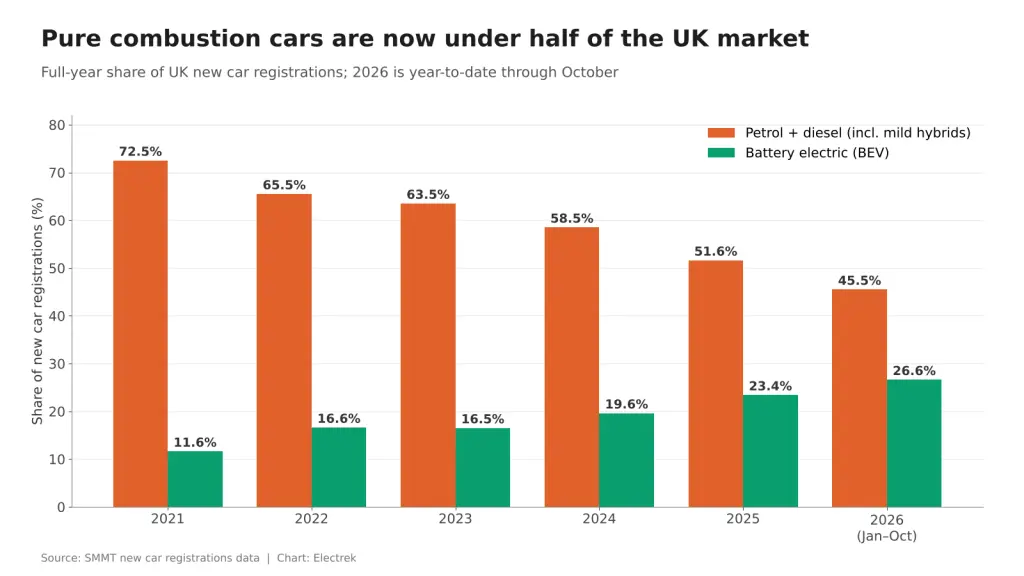
Zoom out to full years and the picture is just as clear. Cars that run only on petrol or diesel, mild hybrids included, made up 72.5% of the UK market in 2021. This year, they’re at 45.5%.
Automakers still want the mandate cut
None of this is good enough for the SMMT, which is using the release to push the government, again, to cut the ZEV Mandate targets.
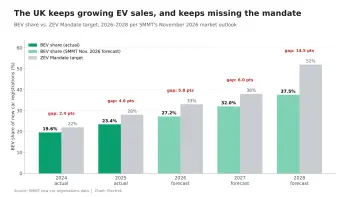
The mandate requires 33% of 2026 sales to be zero-emission. SMMT now forecasts 27.2%. It expects 32% next year against a 38% target, and 37.5% in 2028 against 52%, a 14.5-point gap.
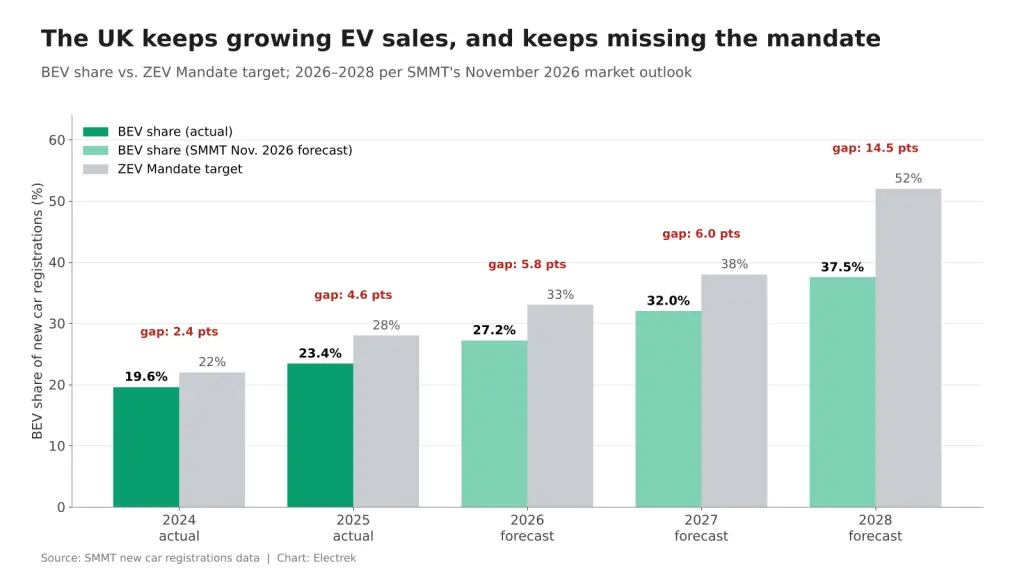
The trade group says automakers have spent “billions” on discounts, 0% financing, deposit contributions, and even subsidized charging to move EVs, on top of the government’s Electric Car Grant. It also slammed last week’s Budget, which confirmed a new EV-specific road tax (eVED) starting in 2028 and kept 20% VAT on public charging.
“Higher targets may force supply, but they do not create demand,” SMMT chief executive Mike Hawes said.
We’ve heard this one before. The SMMT made the same argument after September’s record 99,199 BEV registrations, and the government already opened a review of the mandate this year.
Chinese brands are taking the growth
This might be the main reason why the trade group wants to slow things down. The brands growing fastest in the UK are mostly Chinese. BYD registered 6,065 cars in October, up 73%. Jaecoo more than doubled to 6,089 units, Chery nearly tripled to 3,707, and Leapmotor doubled to 1,773. MG was up 85%.
Tesla, on the other hand, registered just 282 cars in October, down 45% from 511 a year ago. The first month of the quarter is always slow for Tesla in the UK, and the brand is still up 31% year-to-date at 46,526 units after a big September. But it didn’t have a single model in October’s top 10 BEVs, which was led by the Skoda Enyaq (1,568), Mini Countryman (1,494), and Jaecoo 5 (1,465).
Electrek’s Take
The SMMT’s framing is that there’s a “demand gap.” The data shows the opposite. BEV registrations are up 30% this year while petrol is shrinking every single month. That’s not a market rejecting EVs.
And the discounts automakers keep complaining about? That’s the mandate doing exactly what it was designed to do. It forces automakers to sell EVs, so they price them to sell, and buyers respond. Hawes says targets don’t create demand, but cheaper EVs clearly do. October proves it.
Now, is the jump to 52% in 2028 steep? It is steep, but it looks achievable to me. If anything is hurting demand, it’s the government’s own moves: a new EV-only road tax and 20% VAT on public charging. That’s what the industry should be fighting. It’s too early for that.
Either way, petrol’s days as the UK’s default car are numbered. The only question is whether the milestone comes in December or sometime in 2027. Our bet is December.
Charge your electric vehicle at home using rooftop solar panels. Find a reliable and competitively priced solar installer near you on EnergySage, for free. They have pre-vetted installers competing for your business, ensuring high-quality solutions and 20-30% savings, and lease and PPA options let you go solar with zero upfront cost. It’s free, with no sales calls until you choose an installer. Get personalized solar quotes online and receive guidance from unbiased Energy Advisers. Get started here.