
Fuel for thought: hydrogen-powered vehicle trials
Although many operators making the switch to zero-emission vehicles are choosing the battery electric route, trials currently taking place show hydrogen power can support the UK’s long-term challenge of decarbonising fleets of every kind.
The pilot schemes taking place aim to demonstrate how fuel-cell electric vehicles (FCEVs) can meet the real-world demands of everyday fleet operations.
This is particularly the case for operators using heavily loaded HGVs or light commercial vehicles which cover long distances, are engaged in specialist work, or require significant towing capacity.
For example, gas emergency and pipeline service Wales & West Utilities (WWU) has launched a 12-week green hydrogen vehicle trial in Swansea, in collaboration with Ford, of a prototype Ford Transit van.
This work, which builds on a previous hydrogen vehicle trial, aims to show how hydrogen fuel cell technology can meet the operational demands of light commercial vehicles, for example, in utility and construction environments.
The vehicle is equipped with a fuel cell and uses hydrogen produced and delivered by Protium Green Solutions, with refuelling taking place at a facility supported by Fuel Cell Systems at the Hyppo Hydrogen Solutions site in Swansea.
During the trial, WWU operational staff will use the vehicle on a daily basis, driving around the wider Swansea and West Wales area to understand the benefits to the business.
The project team will also assess the vehicle’s potential range, refuelling needs, and payload during a typical working day.
Refuelling with hydrogen at 700bar allows WWU to maximise the potential of a zero-emission light commercial vehicle.
Stephen Offley, Transport Lead for WWU’s Net Zero & Sustainability team, said: “This is clearly an area where we can make huge carbon savings with the right technology.
“This trial demonstrates our commitment to finding the most operationally effective low-carbon solutions for our fleet whilst we continue to provide the reliable and efficient services our customers expect.
“We are confident that hydrogen will have an important role to play in the decarbonisation of road transport as we move away from fossil fuels.”
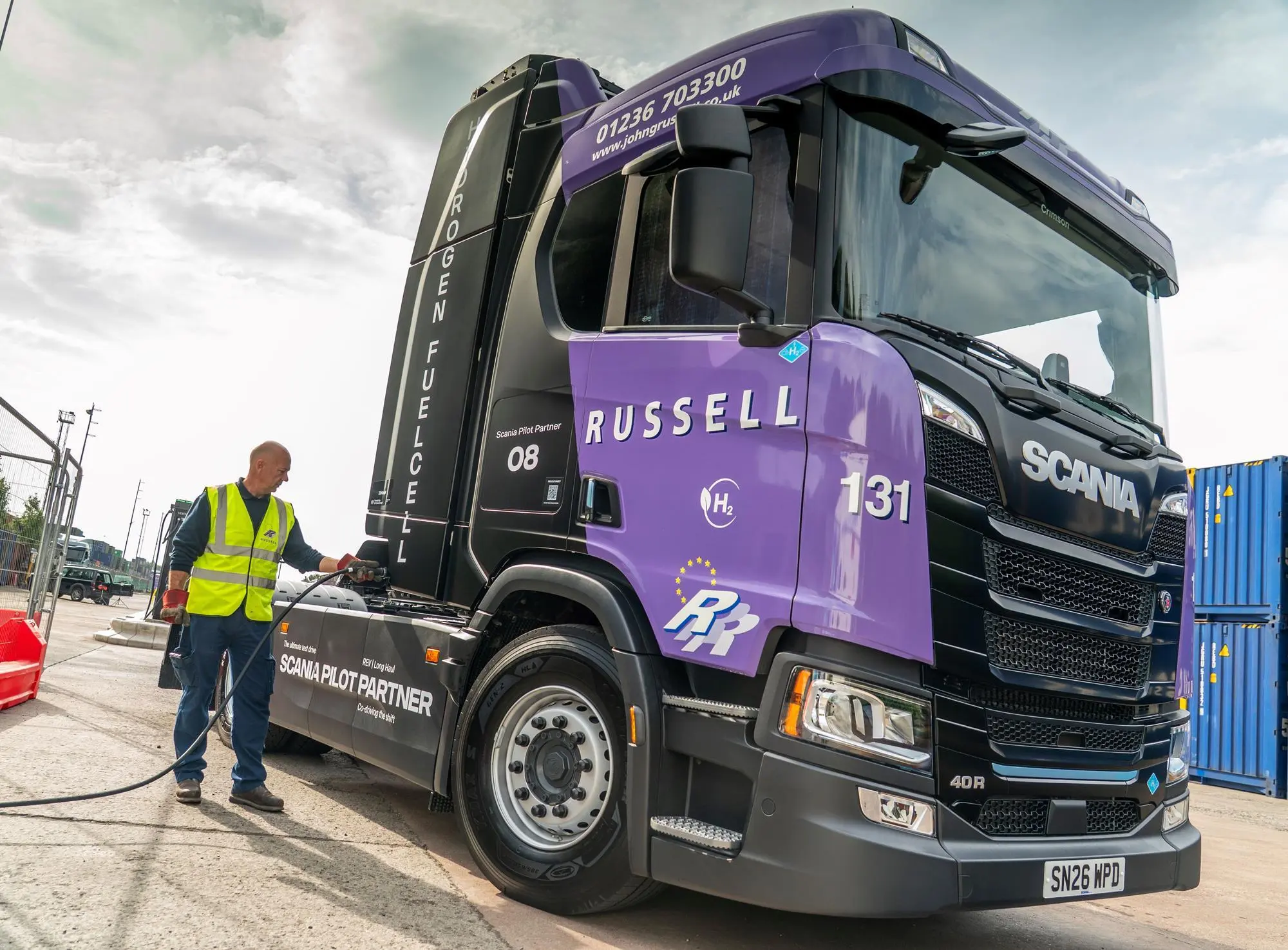
Meanwhile, Glasgow-based haulier John G Russell (Transport) has put three Scania hydrogen FCEVs into its daily operations on UK roads.
The trucks use the latest 6×2*4 battery electric truck platform, and each vehicle features a 400kW electric machine and 416kWh of installed battery capacity.
Scania estimates an electric-only range of up to 186 miles at a gross vehicle weight of 44 tonnes.
A 300kW Cummins fuel-cell system is mounted beneath the cab, while tanks at the rear can carry up to 56kg of hydrogen stored at 700 bar.
The addition of the fuel cell increases the estimated total range to as much as 528 miles.
Each truck’s powertrain can operate using battery or fuel-cell power independently, use both simultaneously, or employ the fuel cell as a range extender for the batteries.
Developed by Scania’s Pilot Partner division, the trucks form part of the ZENFreight project, one of the Government-backed Zero Emission HGV and Infrastructure Demonstrator (ZEHID) programme initiatives.
Stephen Madden, John G Russell Group Fleet Engineer, said: “We identified early on that hydrogen could play a critical role in delivering a true carbon zero solution for non-urban logistics.
“The ZEHID demonstration project marks a significant step forward. It enables us to invest in and trial both hydrogen and battery electric vehicles, along with refuelling solutions, in real-world heavy-duty operations.”
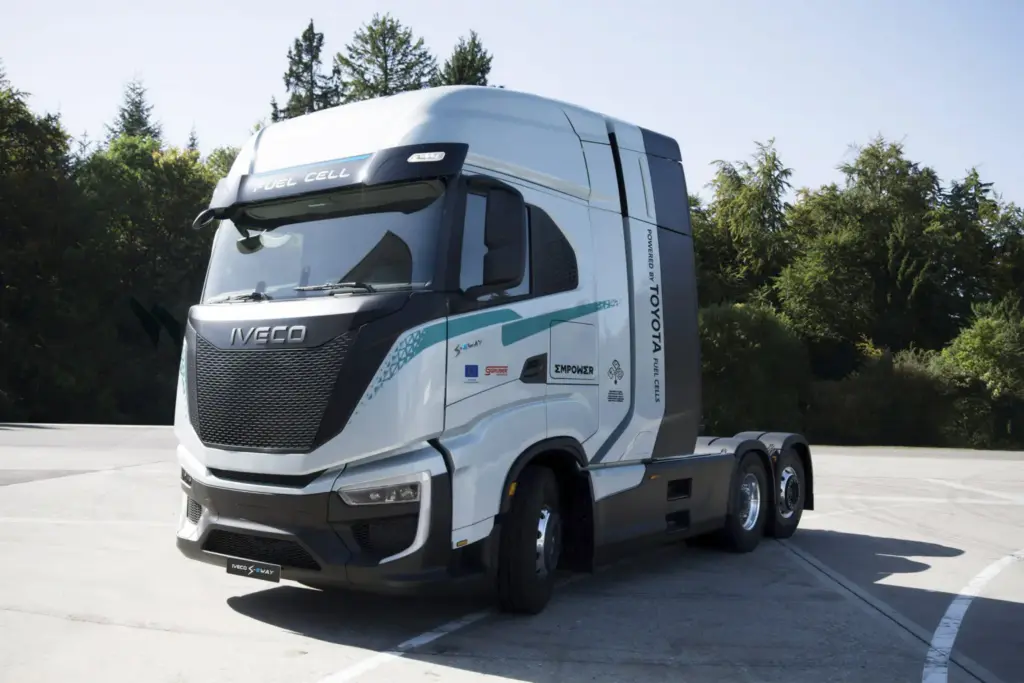
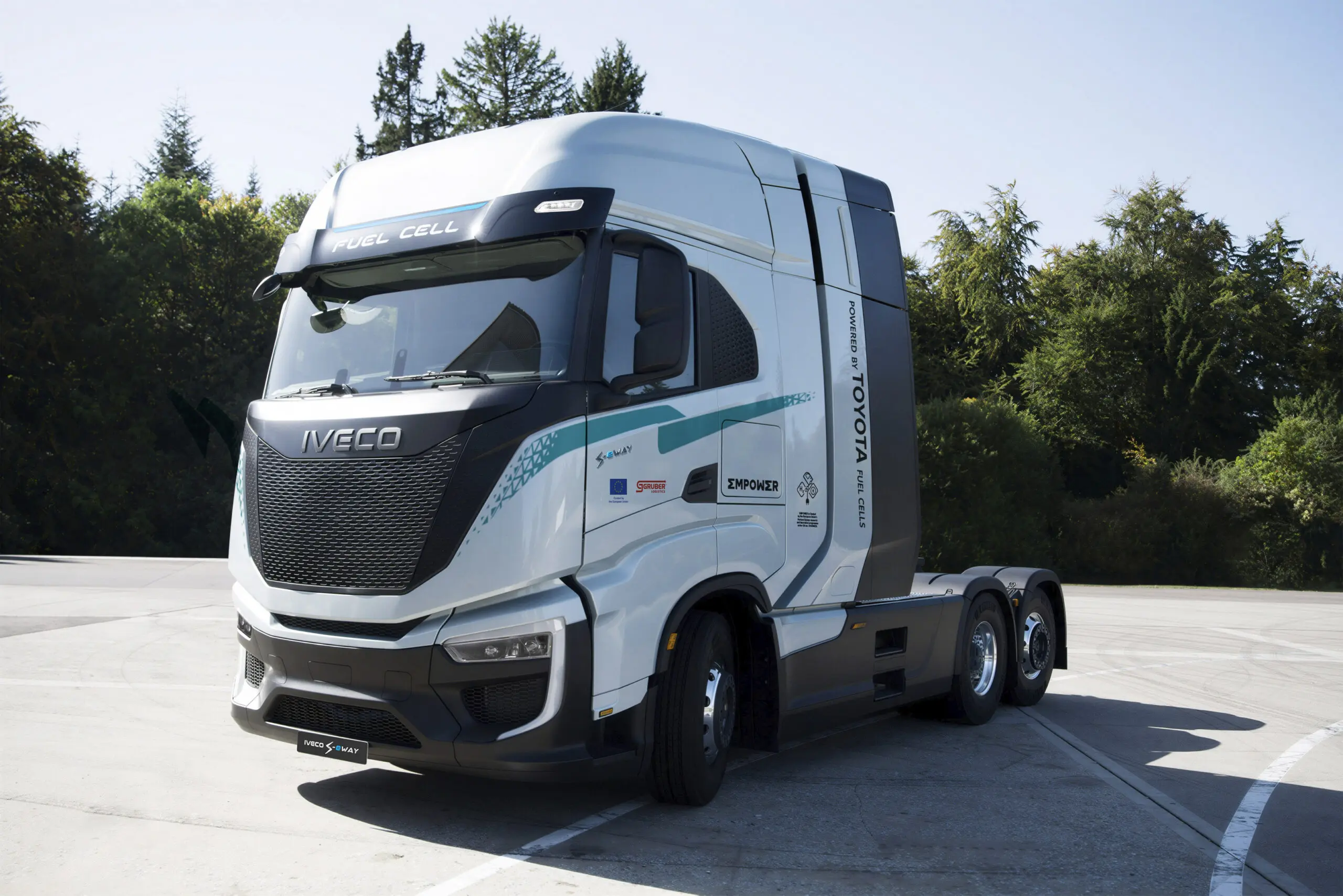
Also, Iveco and Toyota have announced a new collaboration under Empower – the EU-funded Horizon Europe project – dedicated to demonstrating hydrogen technology under demanding real-world heavy-duty operating conditions.
Powered by Toyota fuel cell systems with a total output of 300 kW, the Iveco S-eWay Fuel Cell has a driving range beyond 559 miles.
Compared to earlier models, vehicle weight has been reduced, and the overall architecture has been simplified through a more efficient energy management strategy, requiring only half the battery capacity of the previous generation.
Validation and testing activities are scheduled to begin in the fourth quarter of this year, with on-road trials planned to start in the first half of 2027.
Marco Liccardo, Chief Technology & Digital Officer, Iveco Group, said: “Hydrogen is a key enabler of the future energy and mobility ecosystem.
“By joining forces with Toyota through Empower, we are investing in a long-term vision for heavy-duty transport, one that combines sustainability, energy resilience and operational performance.”
Shinichi Yasui, Executive Vice President, R&D, Toyota Motor Europe, said: “For high-mileage, heavy-duty operations, hydrogen fuel cell technology offers strong potential by combining range, uptime and efficiency.
“By working together with Iveco, we aim to demonstrate how Toyota’s third-generation fuel cell system can help customers move towards zero-tailpipe emission logistics without compromising operational needs.”
A Sisu electric truck with a hydrogen fuel cell is due to commence a six-month trial in Finland, operating at gross combination weights of up to 68 tonnes.
The trial, led by VTT Technical Research Centre of Finland, will examine energy consumption, reliability and the effects of winter weather on battery and fuel cell performance.
Developed under the EU-funded Escalate project, the Sisu Escalate has a 650kWh battery and a 120kW hydrogen fuel cell, which provides extra electricity during longer journeys.
The vehicle will be operated by Jylhä Logistics between Vuosaari harbour in southern Finland and Jyväskylä in central Finland, covering about 336 miles per day.
It will use charging facilities at both ends of its route, with hydrogen supplied from a refuelling station in Jyväskylä.
Ioncor developed the battery system, while Kempower provided megawatt charging infrastructure, with Hevtec integrating the electric powertrain.
The trial of this research vehicle is scheduled to begin before the end of 2026.
Petri Kananen, Head of Development at Sisu Auto, said: “With the learnings from the pilot, we can choose the best solutions for a product series developed for the market.
“The data will help us develop energy management systems and optimise driving with the battery to maximise the distance that can be driven with electricity.”
The insights gained from the current trials will therefore be invaluable in helping industry and government understand where hydrogen can play a role alongside battery electric solutions in the future.
BACK TO ALL NEWS