
How RADOX® from HUBER+SUHNER meets new EV architecture demands
Now a focal point of automotive fleets, the next stage of EV evolution is centered around reducing the space and weight of architectures to unlock further driving range as well as improving thermal management to enable faster charging.
One area attracting renewed interest to facilitate this is rethinking the components that surround the vehicle powertrain. This includes the high voltage (HV) cables that act as the main arteries of an EV, transmitting high power electricity from the traction battery to core drivetrain and auxiliary components.
Traditional cable setups have been oversized by design to safely contain the jump to 800V and added severe Electromagnetic Interference (EMI), contributing to a heavier vehicle architecture. With Original Equipment Manufacturers (OEMs) demanding lighter vehicles, the first step must come in the form of downsizing these cables and improving thermal management without compromising performance.
Introducing RADOX®
One proven approach to this problem is the pioneering RADOX® technology from HUBER+SUHNER. A specialized leader in specific high-performance niches of the automotive and transportation sector, RADOX® technology was initially built over four decades ago using expert Swiss engineering.
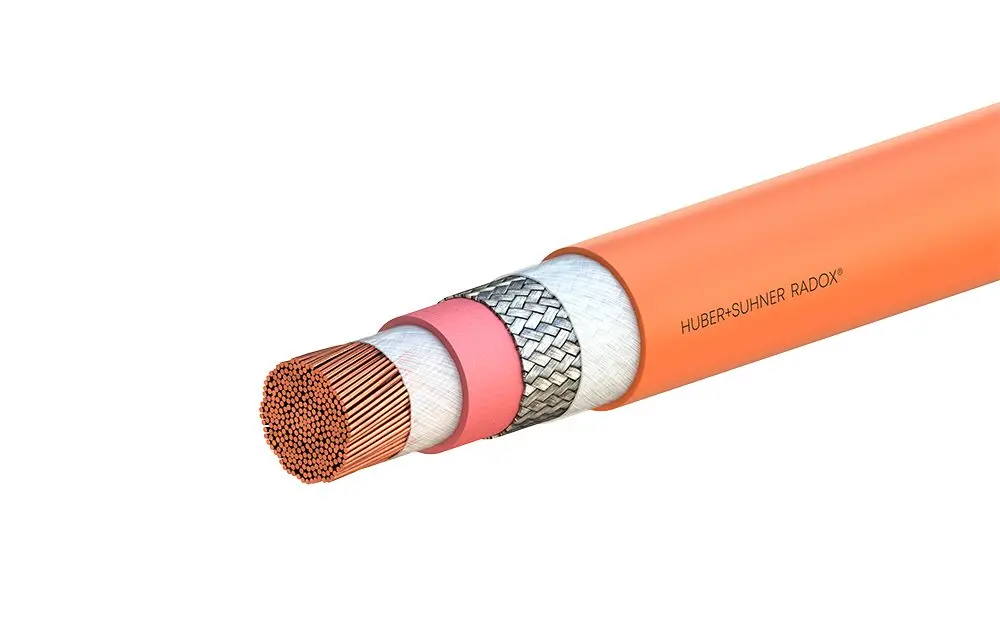
RADOX® stands for radiation crosslinking, referring to the process of crosslinking thermoplastic polymers using electron beams. The cables never melt, possess better abrasion and cut resistance, greater flexibility, and even with thinner insulation, are more resistant to harsh environments, making them a natural fit for the abundance of exposures present in EVs.
While RADOX® has already been demonstrated its capabilities across demanding applications in rail, offshore energy, and fiber optics, its performance in the automotive and EV sector presents another compelling use case for the technology – particularly as corrugated tubed HV cables prove surplus to requirements across many vehicle applications.
Breaking with tradition
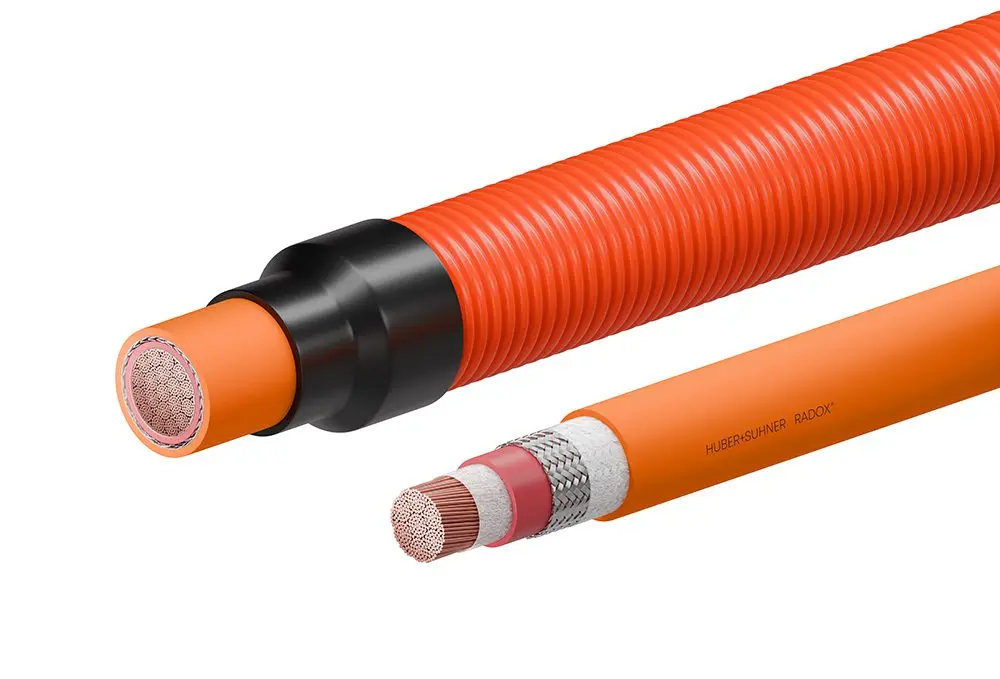
Corrugated tubes became a staple in EV environments as they solve the unique mechanical, thermal, and safety challenges introduced by high voltage powertrains. Essentially, they provided a simple way to shield HV cables from moisture, chemicals, and other harsh environmental conditions.
The process also became commonplace as using heavy rigid conduits or thick solid rubber hoses was unfeasible. The advanced polymer from corrugated tubes offered a high crush-resistance and structural rigidity, allowing automotive to cut down massive amounts of structural weight in comparison to archaic alternatives.
Despite this, there’s still a demand to cut weight even further in EV platforms. Corrugated tubes are now deemed redundant for this task, with many high voltage applications witnessing a rise in thermal and structural engineering bottlenecks with corrugated tubes present. Implementation can limit how light and compact a vehicle can be, and if heat can dissipate properly.
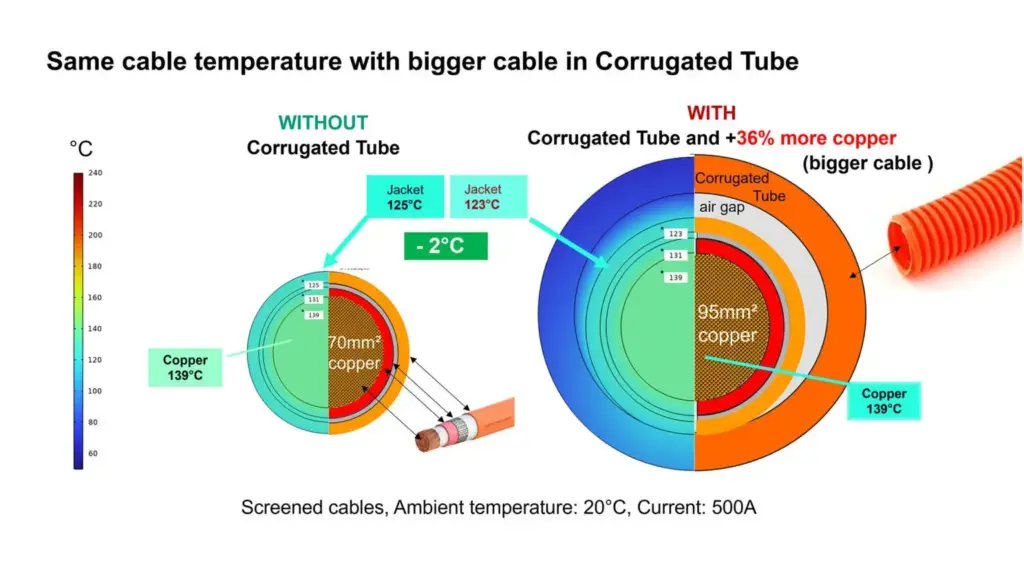
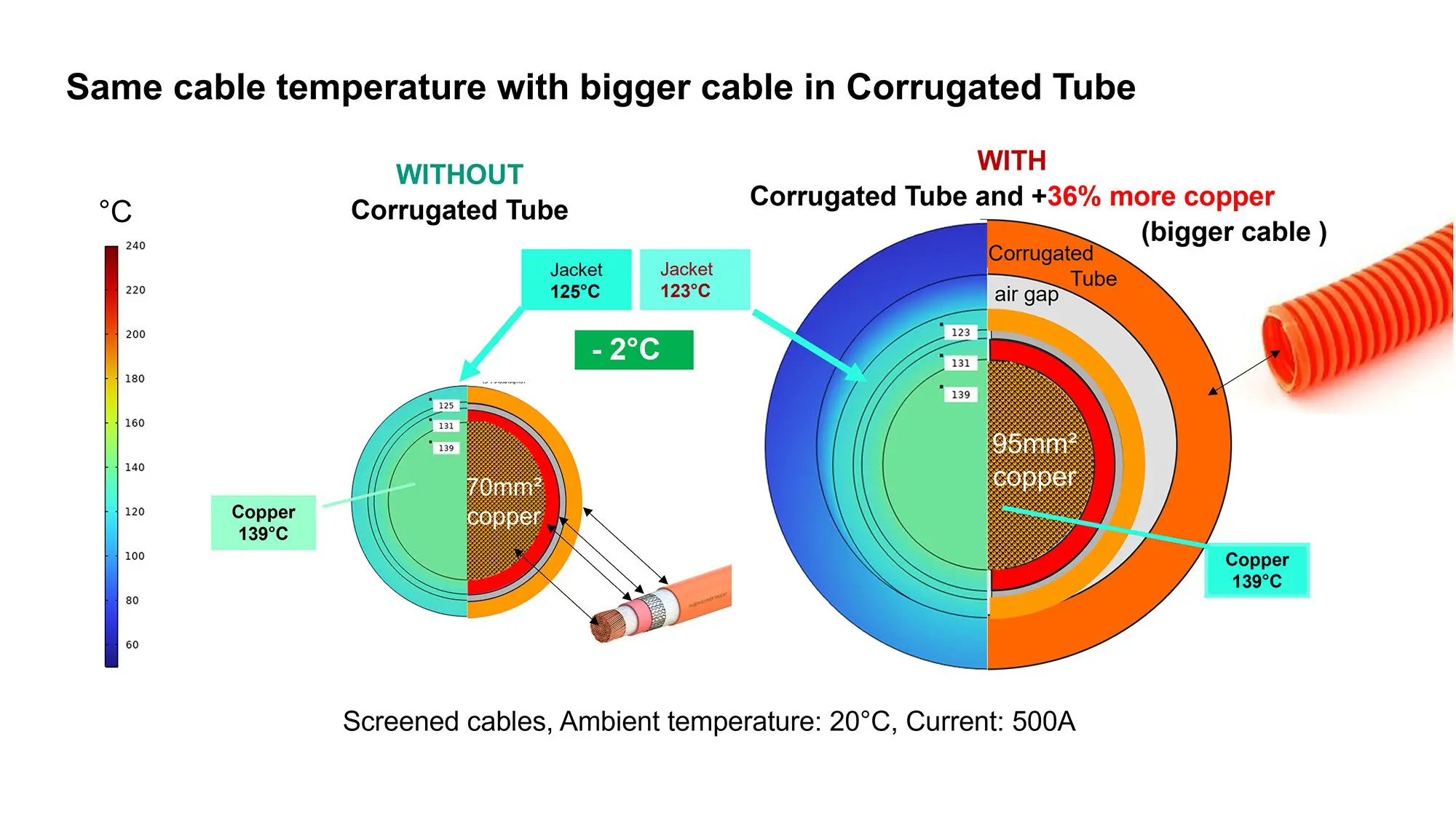
By enclosing the cable, a corrugated tube traps heat and reduces airflow around the conductor. Higher operating temperatures increase electrical resistance, which in turn generates additional heat and power losses. Simply put, this cycle accelerates thermal aging and can reduce cable performance, reinforced by the Arrhenius rule that states every 10°C increase in operating temperature can reduce insulation lifetime by 50%.
As heat builds up, the electrical resistance of the wire also increases over time, forcing engineers to derate the cable, significantly changing how the system operates to protect safety and equipment. To overcome these bottlenecks, corrugate free alternatives were soon firmly fixed in the crosshairs of OEMs, with RADOX® leading the charge away from the corrugated approach to cabling.
Improving heat dissipation
One way that RADOX® cables directly unlocks the next stage of evolution for EVs is by significantly improving thermal management, specifically heat dissipation. Through its electron-beam radiation cross-linking process, the molecular structure of the cable’s polymer insulation is altered, turning the cable jacket into its own robust mechanical shield, entirely eliminating the need for a corrugated tube.
This innovative design allows the cable to operate up to continuous temperatures of 150°C, and because they can be routed in free air rather than tight bundles, heat can be dissipated seamlessly. Cumulative thermal build up is reduced as the cables are given more space to breathe, and free air installation keeps the derating factor at or near 1.0, the equivalent of no reduction.
Recent testing from HUBER+SUHNER reinforced this. Studies demonstrated that a 95mm2 cable trapped inside a corrugated tube can be replaced by a slimmer 70mm2 RADOX® cable in free air, reducing weight by 25% to 30%, carrying the same exact 500 A current load and adhering to the same safety performance, with a weight reduction between 25% to 30%.
Further weight reductions
The improved heat dissipation delivers benefits beyond thermal performance too. If protection is incorporated into the cable itself – just as it is with the RADOX® range – oversized conductors or protective tubing can reduce overall cable dimensions, as seen in the testing. This is music to the ears of OEMs given the amounting pressure to unlock greater vehicle range and reduce vehicle weight.
RADOX® is an industry standard blueprint in achieving the triple win of reducing vehicle weight, cutting manufacturing costs, and freeing up tightly packed spatial routing. In fact, the full solutions portfolio boasts a smaller overall conductor cross-sectional area, leading to weight reductions when compared to corrugate conduits and assemblies in several deployments.
As well as weight reductions, OEMs can expect cost reductions when deploying RADOX® solutions. Upon switching to a thinner RADOX® cable, the physical footprint of the entire vehicle connectivity system shrinks: connectors, cable-trays, multi-cable transits (MCTs) and pass-throughs like the RADOX® EV-C connection system can all be downsized. Cable assembly costs are consequently reduced, copper consumption is reduced, and the vehicles carbon footprint is slashed.
Making up ‘triple win is tightly packed spatial routing – an important consideration in areas such as battery-to-inverter connections, where large conductors carry significant current through congested architectures. With RADOX® solutions such as the Screened FLEX family increasing cable flexibility by 15% to 30%, much tighter, more compact powertrain modules can be designed because the cables can snake through highly restricted spaces.
Your next EV partner
The RADOX® family demonstrates how mechanical robustness, high temperature capability, and tight bend radii for complex packaging can all coexist in one singular cable to unlock the next wave of evolution for EVs.
As a leading automotive supplier, HUBER+SUHNER supports customers with adopting and implementing RADOX® cables into EV platforms. Thermal behavior is tested and modelled by our engineering teams for real installation scenarios such as free air, conduits, bundling, and ambient profiles. Only with a partner as meticulous as HUBER+SUHNER can automotive OEMs be fully assured that future EV platforms are to perform as expected.
Through our local manufacturing partners, we serve the Automotive with fast, reliable, and efficient support to our North American customers, forming a key pillar of our extensive international reach. Every solution across our automotive portfolio is rigorously validated against North American and global automotive standards.
Together with leading OEMs, we’re helping EVs connect the future – today and beyond. For more information on RADOX® in the North American region, visit here.