
Year-end push lifts EV sales but Mandate gap set to widen
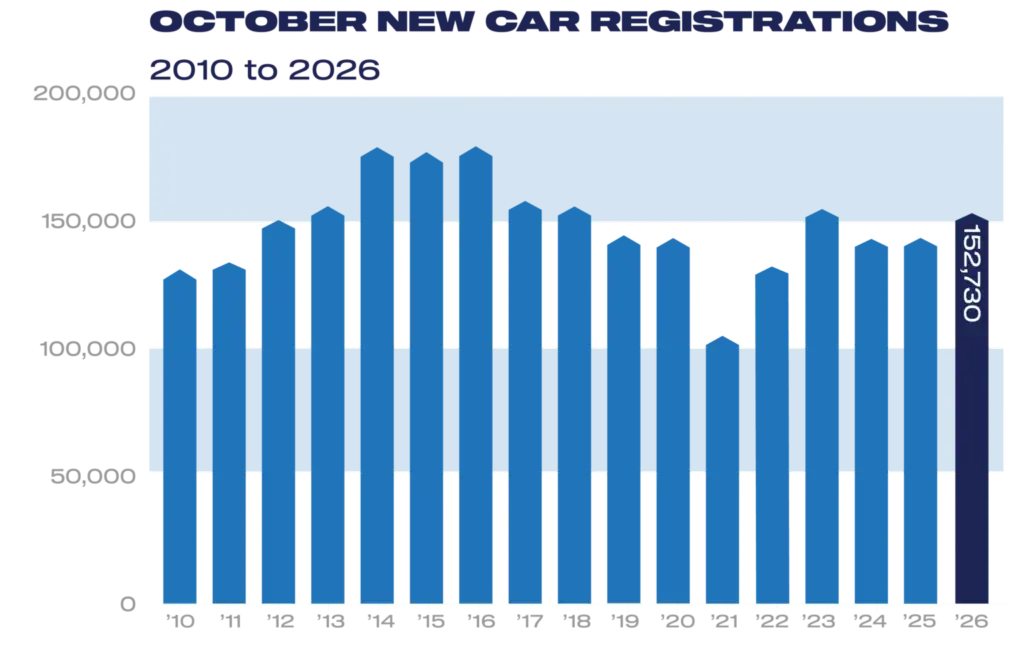
- New car market grows 5.4% in October, its 11th consecutive month of growth.
- Battery electric cars take 32.0% of registrations as buyers respond to growing model choice and compelling offers, but year-to-date share just 26.6%.
- Latest outlook forecasts demand gap to double by 2028 – despite intensive manufacturer support.
- Industry calls for maximum Mandate reform this year, to protect investment, jobs and deliver a successful transition.
Data download
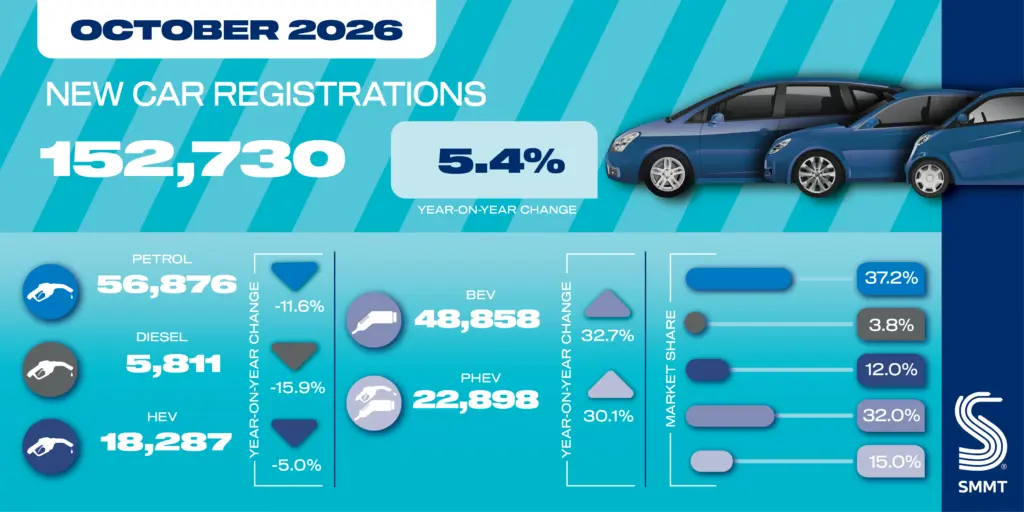
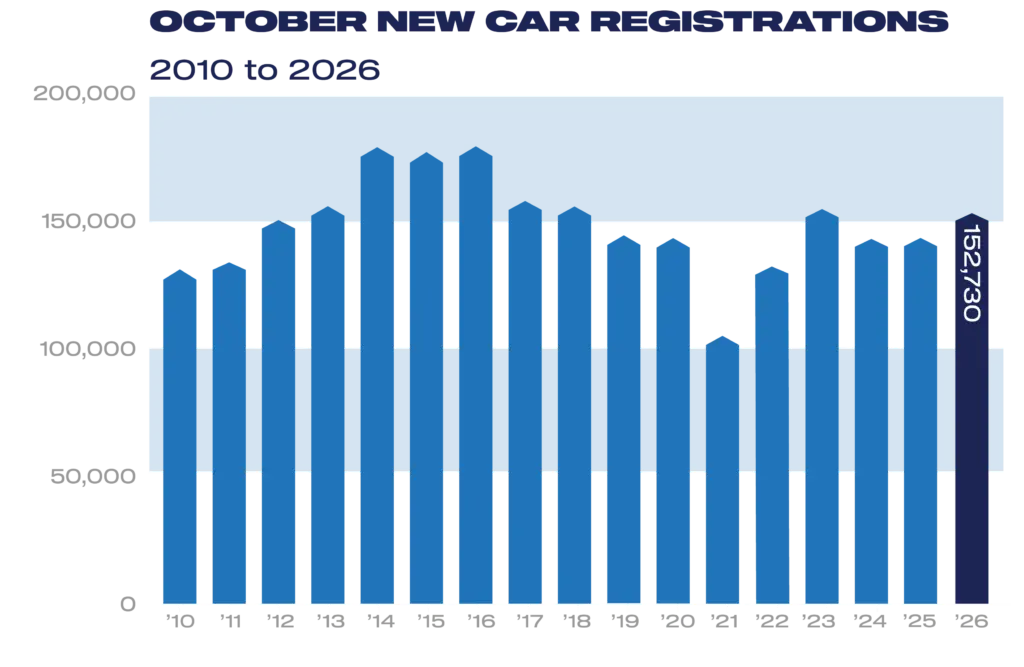
The UK new car market rose 5.4% to 152,730 registrations in October, according to the Society of Motor Manufacturers and Traders (SMMT). The performance marks the 11th consecutive increase, albeit at around half the growth rate seen across the first 10 months of the year after a bumper number-plate change September.1
Growth was recorded across all sales types. Fleet registrations rose 5.4% to 89,985 units, accounting for 58.9% of the market, while private demand increased 4.1% to 58,229 units and a 38.1% share. Business registrations climbed 24.5% to 4,516 units.
Plug-in hybrid (PHEV) and battery electric (BEV) cars accounted for all of the growth. PHEV registrations rose 30.1% to take a 15.0% market share, while BEV deliveries increased by 32.7% to secure 32.0% – their highest share this year as manufacturers intensified efforts to bring registrations closer to the annual mandated target, repeating the pattern of the previous two years. Hybrid (HEV) volumes declined for a second month, down -5.0%, but, together, electrified cars accounted for almost six in 10 (59.0%) registrations.
More than half a million (503,805) BEVs have been registered this year, up 30.4% on a year ago. Manufacturers are backing the transition with major investments in technologies, factories and workforces worldwide, including £14.3 billion committed to UK EV manufacturing since 2020. That investment has delivered more than 180 BEV models to the current market, offering an average range in excess of 300 miles on a single charge.2
Manufacturers need to make a return on such investments to fund future products and jobs. Yet the ZEV Mandate targets were set in very different global and domestic economic conditions, and manufacturers have since been forced to spend billions on discounts, low and 0% finance, deposit contributions and even subsidised charging to incentivise sales beyond underlying demand. Doing so on brand new electric models undermines the UK’s attractiveness as a market and manufacturing location, eroding profitability, with a long-term consumer detriment as lower trade-in values leave owners less able to afford their next car.
Despite the billions in incentives, including government’s Electric Car Grant, BEV share is expected to reach 27.2% this year against the 33% ZEV Mandate target, according to the latest market outlook.3 The gap is also set to widen next year with a 32% share expected against a 38% target. By 2028, BEV share is expected to reach 37.5% – 14.5 percentage points behind the required 52%, more than double this year’s shortfall.
The industry is therefore urging government to make substantive changes to the targets, revising them down so they better reflect demand, alongside full flexibilities throughout the regulation to bridge the remaining gap. Last week’s Budget contained little to drive the market. Indeed, the confirmation of a new EV-specific tax (eVED) from 2028 and proposed regulation to retain VAT on public charging at 20% while domestic use is currently VAT-free sends mixed messages to consumers. Policy must make switching easy, with long-term certainty on grants and other incentives, disincentives removed, and public charging made cheaper and more accessible. A healthy market is vital to decarbonisation and to the UK’s £85 billion automotive industrial base on which 188,000 jobs depend.
Mike Hawes, SMMT Chief Executive
Almost one in three new cars registered in October was electric – great progress in the transition, but one that comes at enormous cost. The industry and government are spending billions to help drivers switch, but that support cannot be sustained indefinitely with the gap to mandated targets set to more than double by 2028, just as a new EV-only tax is introduced. Higher targets may force supply, but they do not create demand. The ZEV Mandate review must deliver substantive reform effective immediately to ensure we have a healthy market and an attractive pitch to investors.
Notes to editors
- 9.8% growth rate in first ten months
- SMMT analysis
- SMMT November Market Outlook
SMMT Update
Sign up
Sign up to the SMMT Update Newsletter for weekly automotive news and data
“*” indicates required fields
BACK TO ALL NEWS