
BYD’s electric hypercar hits 312 mph, first production car over 500 km/h
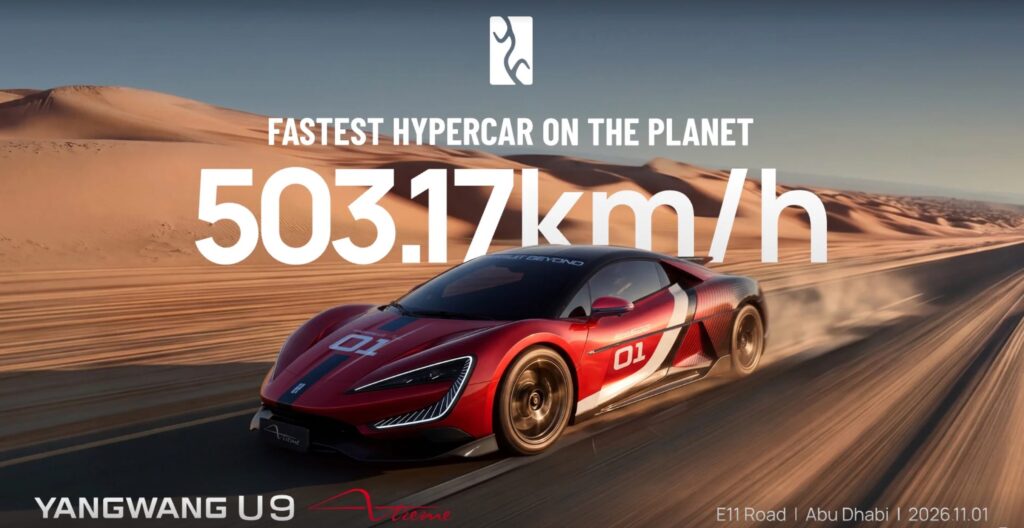
BYD’s Yangwang U9 Xtreme just reached 503.17 km/h (312.66 mph) on a closed highway in Abu Dhabi, making it the first production car ever to go faster than 500 km/h.
The FIA and Guinness World Records both recognized the run. It’s the all-electric hypercar’s second top-speed record in just over a year, and the one it broke was its own.
From 496 km/h to 503 km/h
BYD announced the record on X this morning, saying the U9 Xtreme “has done the impossible” and calling it “the fastest production car on the planet.”
Abu Dhabi closed a 10 km section of the Sheikh Khalifa Bin Zayed International Road (E11), in the emirate’s Al Dhafra Region, for the attempt. That gave the team a 7 km straight. Marc Basseng, the German racing driver who set the car’s previous record, was behind the wheel again.
Advertisement – scroll for more content
It took two days. Basseng maxed out at 490 km/h on the first day, per the FIA. After an overnight round of changes to the rear wing, damping, and tire pressures, he got to 503.17 km/h on his second attempt of November 1.
The previous mark was 496.22 km/h (308 mph), set at Germany’s ATP Papenburg proving ground in September 2025. That run had already pushed the Bugatti Chiron Super Sport 300+ and its 490.48 km/h from 2019 off the top of the list.
And it comes just days after BYD released footage of a U9 Xtreme crashing into a guardrail at about 280 mph during an earlier high-speed test. The driver walked away unharmed. BYD went right back out and hit 457.89 km/h on the next run.
3,000 PS, 1,200 volts, 30 cars
The U9 Xtreme is the track-focused version of the Yangwang U9, the flagship supercar from BYD’s luxury brand. It uses four electric motors, each rated at 555 kW and spinning up to 30,000 rpm, for 2,220 kW combined. That’s over 3,000 PS, or nearly 3,000 hp.
It runs on a 1,200-volt architecture with a track-grade version of BYD’s Blade Battery. Those are LFP cells, the same chemistry BYD puts in its cheapest city cars.
For context, the Rimac Nevera R, which snagged a pile of EV world records last year, tops out at 431.45 km/h. The U9 Xtreme also holds the production EV lap record at the Nürburgring Nordschleife at 6:59.157.
Only 30 will be built, and BYD is charging around $3 million apiece. Don’t expect to see one in the US, where BYD doesn’t sell passenger cars.
But there are asterisks
The biggest one: this is a single-direction run. The two Guinness titles listed for the attempt, highest speed by a production car and by an electric production car, are both specified as “single direction.” BYD’s post claims four Guinness records, but the FIA’s announcement only lists those two for this run.
Production car top speed records have traditionally been the average of two runs in opposite directions, within an hour, to cancel out wind and road grade. That’s how Koenigsegg got its 447.19 km/h record with the Agera RS in 2017.
Bugatti took heat for exactly this in 2019, when the Chiron hit 490 km/h one way on a pre-production car. Bugatti itself said it wasn’t an official record.
The car also ran on bespoke semi-slick tires developed with Giti Tire. It’s not clear whether the 30 customer cars will get them.
Electrek’s Take
Asterisks aside, this is wild.
A Chinese automaker best known for $10,000 city cars now builds the fastest production car in the world, and it’s electric. Not long ago, the conventional wisdom was that EVs couldn’t sustain high top speeds because the battery and motors would overheat long before the car ran out of road. BYD just ran 503 km/h on LFP cells. LFP cells!
But we’d hold BYD to the same standard we held Bugatti to. A one-way run on a highway with a 7 km straight is a great demo, not a definitive record, but impressive nonetheless.
And either way, let’s be honest: this is about marketing. Nobody is going to drive one of these 30 cars at 500 km/h. But it works. It’s a halo for Yangwang ahead of its new ultra-luxury sedan and for BYD’s push into Europe, and it makes the “Chinese cars are cheap copies” crowd look out of date.
Meanwhile, Tesla promised a Roadster that would hit over 250 mph back in 2017. Nine years later, it’s still not in production.
The real question now is whether Bugatti or Koenigsegg answers with a two-way 500 km/h run. Koenigsegg says its Jesko Absolut can theoretically do it, but it has never attempted a run. Is BYD what finally makes them try?
If you’re buying an EV, powering it with home solar can cut your fuel costs to nearly zero. With electricity rates up almost 10% last year and expected to keep climbing, going solar is one of the best ways to protect yourself against rising costs. And with lease and PPA options, you can do it with zero upfront cost and start saving immediately. If you want to find the best deal, check out EnergySage. It’s a free service with hundreds of pre-vetted installers competing for your business, so you save 20 to 30% compared to going it alone. No sales calls until you pick an installer. Get your free quotes here.
Source: electrek.co — article syndicated from the publisher’s feed; all rights remain with the original publisher.