
Too Much Motion in the Ocean: We Test the 2027 Mercedes-Benz GLS450
You can have the world’s best cartographers in your employ, and your ship can still end up drifting off course. The 2027 Mercedes-Benz GLS450 is one such boat. Mercedes has buildings full of nitpicky engineers whose sole collective life goal is to build the most comfortable three-row SUV on terra firma. And while the result of the GLS’s latest refresh largely hits the mark, we believe this ute’s ride quality missed its intended landing zone.
Let’s focus on the high points first. We’re big fans of the base GLS450’s 3.0-liter turbocharged inline-six. Thanks to a stronger electric supercharger and a few other updates, this powertrain now spits out 375 horsepower and 413 pound-feet of torque fed through a nine-speed automatic transmission to all four wheels. With it, the GLS450 managed a solid 5.1-second sprint to 60, eventually clearing the quarter-mile mark in an equally respectable 13.6 seconds at 101 mph. Not bad for a gas-powered machine that tipped our scales at 5623 pounds.
Out in the real world, the powertrain only ever feels smooth. Whether we’re stomping on the right pedal or just breathing on it, the result is the same: a muted little growl and plenty of grunt. The transmission stays out of the spotlight; in fact, everything hiding under the body does its best to stay out of earshot. Our microphones picked up very little cabin noise, recording just 65 decibels (20 sones) at a 70-mph cruise. Insofar as high-end family transportation goes, the GLS450 nails that part of its assignment.
More on the GLS450
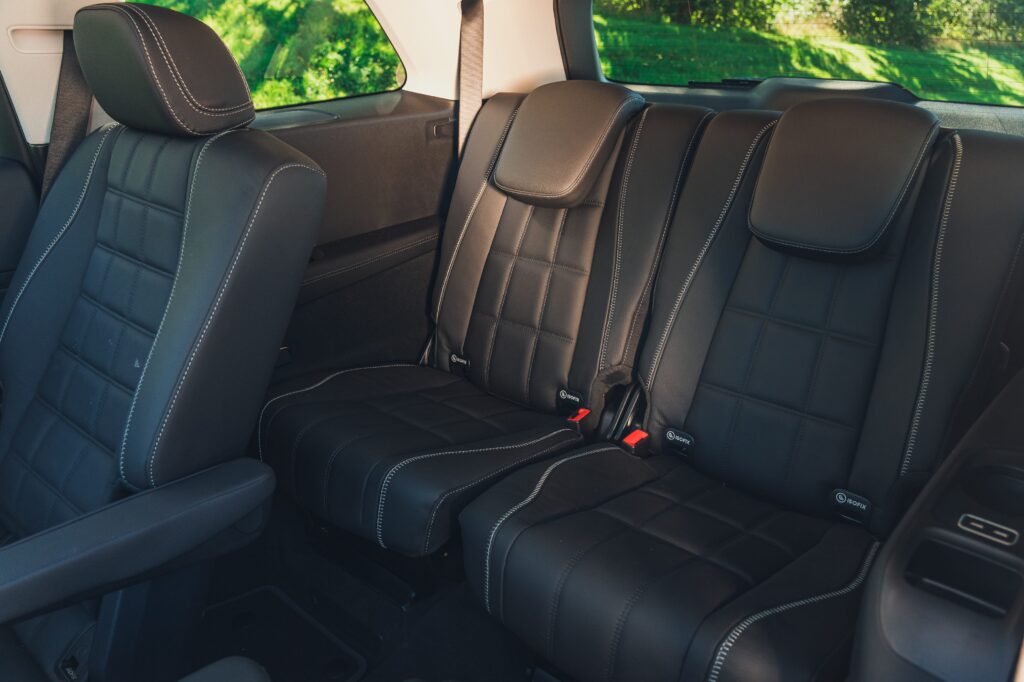
The GLS450’s cabin also succeeds in its goals—mostly. The materials are standard Mercedes-Benz fare, with plenty of nice-feeling leather and vinyl up top, while most of the harder materials remain low in the cabin, away from traditional touch points. Our test car had the no-charge six-seater option; the captain’s chairs in the second row are cushy and make third-row ingress and egress a breeze. The car’s so dang large that even adults can be reasonably comfortable all the way in back, with decent headroom and legroom that’s fine for short jaunts around town.
However, our editors didn’t fully embrace the cabin’s centerpiece: the Superscreen. This panoply of digital real estate spans the entire width of the dashboard, with a single piece of glass encasing the digital gauge cluster, the primary infotainment touchscreen, and the optional (and wholly superfluous) passenger screen. It’s basically eliminated the need to design a dashboard, which does a disservice to those who appreciate an aesthetic other than Blade Runner Dystopia. In fact, this pixel addiction is a growing problem across the entire Mercedes lineup. But hey, at least the steering wheel picked up a physical rocker and a thumbwheel.
HIGHS: Plush over smooth roads, effortless inline-six power, solid space across all three rows.
Marc Urbano|Car and Driver
When it comes to the external half of the GLS-class’s refresh, the whole look gels, but like the revised S-class sedan before it, we’re wondering if Mercedes is going too hard in the paint on the self-branding. In addition to the gigantic three-pointed star on the grille, the grille itself now contains dozens of little three-pointed stars. Each headlight now has two three-pointed stars acting as running lights. In total, the rear lights contain six three-pointed stars. It’s a great design if you’re constantly forgetting what car you bought. Who are they trying to sell this thing to, the protagonist from Memento?
LOWS: Unibody-defying wiggles over bad roads, three-pointed-star overload, how much screen is too much screen?
The GLS450’s more prominent bugbear is its ride quality. Ordinarily, a plush ride means road inconsistencies disappear, replaced with a body that floats serenely over juts and ruts without transmitting undue movement to the cabin and its occupants. In the GLS450, though, it appears the suspension engineers were tasked with reinventing body-on-frame jiggle from first principles. On any road that isn’t obsidian smooth, the GLS suffers from an awful lot of lateral wobbling after tackling a bump, and the body barely settles down by the time the next one arrives. It’s as if the engineers benchmarked an unladen F-350. Our test car was riding on the stock air suspension, and while it’s possible that upgrading to the electrohydraulic E-Active Body Control system would eliminate these unwanted movements, we’re let down that this setup ever left the plant in Alabama.
Despite a terminal case of the Wibbly-Wobblies, GLS450 proved surprisingly sticky around our 300-foot skidpad. We managed 0.92 g of lateral grip from the Pirelli P Zero PZ5 summer tires (285/40R-23 front, 325/35R-23 rear). The GLS also stopped from 70 mph in a tidy 154 feet. We’d appreciate these stats more if they didn’t come attached to a four-wheeled waterbed.
VERDICT: Germany’s most capable and expensive waterbed.
As if it wasn’t obvious from its segment positioning, the Mercedes GLS is an expensive proposition. It starts at $95,500, and you do get a good amount of standard equipment, including heated and ventilated front seats, air springs, all-wheel drive, and the Superscreen. Our test car picked up several add-ons—including $1620 for real leather and $3300 for the AMG Line design package—ballooning the price to $113,670. There’s a lot to like about the refreshed 2027 GLS450; we just wish ride quality was on that list.
➡️ Skip the lot. Let Car and Driver help you find your next car.
Specifications
Specifications
2027 Mercedes-Benz GLS450 4Matic
Vehicle Type: front-engine, all-wheel-drive, 6-passenger, 4-door wagon
PRICE
Base/As Tested: $95,500/$113,670
Options: 23-inch AMG Twin 5-Spoke wheels in Black with summer tires, $3250; AMG Line (AMG body styling, illuminated Mercedes grille star, enhanced engine sound, AMG floor mats, nappa leather-wrapped sport steering wheel), $3300; Pinnacle package (heated and cooled front cupholders, multicontour front seats with massage, heated rear seats, soft-close doors, Air Balance package), $2700; MB.Drive Assist Pro 3-year subscription, $2000; Black leather upholstery, $1620; Warmth and Comfort package (heated front and rear armrests, rapid heating front seats, Winter package), $1200; Acoustic Comfort package, $1100; head-up display, $1100; illuminated running boards, $650; 5-zone climate control, $500; rear side airbags, $350; MBUX dashcam, $200; Night package, $200
ENGINE
supercharged, turbocharged, and intercooled DOHC 24-valve inline-6, aluminum block and head, direct fuel injection
Displacement: 183 in3, 2999 cm3
Power: 375 hp @ 6100 rpm
Torque: 413 lb-ft @ 2000 rpm
TRANSMISSION
9-speed automatic
CHASSIS
Suspension, F/R: control arms/multilink
Brakes, F/R: 14.8-in vented disc/13.6-in vented disc
Tires: Pirelli P Zero PZ5
F: 285/40R-23 107Y MOS PNCS
R: 325/35R-23 111Y MOS PNCS
DIMENSIONS
Wheelbase: 123.4 in
Length: 205.4 in
Width: 79.0 in
Height: 71.8 in
Passenger Volume, F/M/R: 54/57/39 ft3
Cargo Volume, Behind F/M/R: 85/43/17 ft3
Curb Weight: 5623 lb
C/D TEST RESULTS
60 mph: 5.1 sec
100 mph: 13.4 sec
1/4-Mile: 13.6 sec @ 101 mph
130 mph: 29.4 sec
Results above omit <a href="https://www.caranddriv
Source: www.caranddriver.com — article syndicated from the publisher’s feed; all rights remain with the original publisher.